


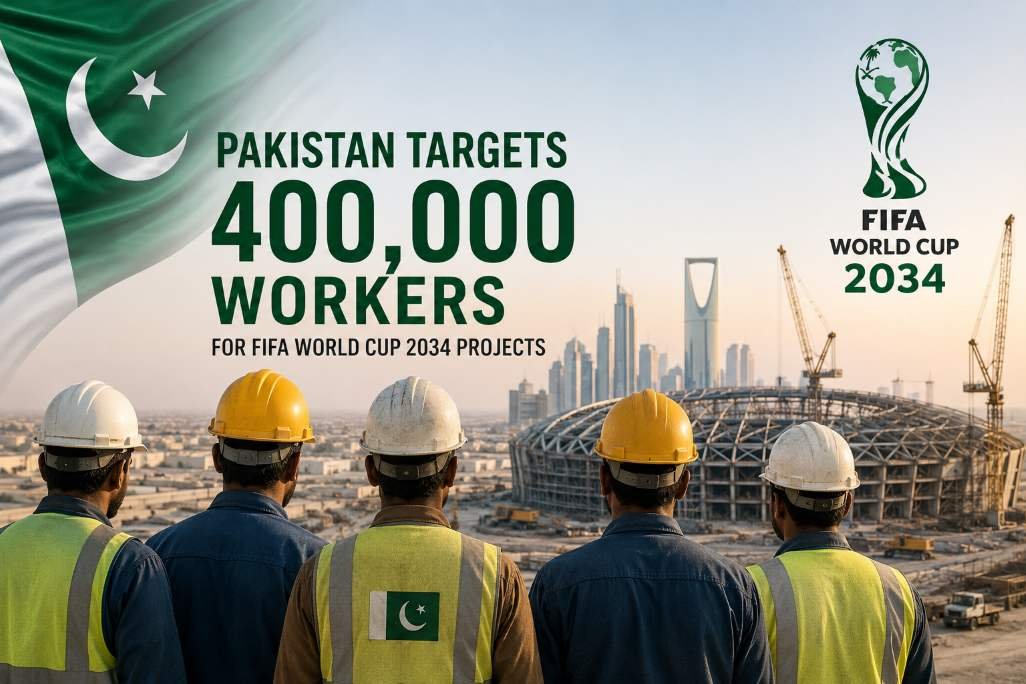
ISLAMABAD, June 21 (ABC): Pakistan is targeting the training and deployment of 300,000 to 400,000 workers for projects linked to the FIFA World Cup 2034 as part of a broader strategy to expand overseas employment opportunities and strengthen the country’s position in international labour markets.
According to official documents available with Wealth Pakistan, workforce planning aligns with anticipated demand arising from the FIFA World Cup 2034. Trained Pakistani workers are expected to support infrastructure development, aviation, tourism and related service sectors between 2026 and 2034.
The initiative forms part of the government’s wider efforts to boost manpower exports and enhance the skills profile of Pakistani workers for overseas employment.
Skills development supports overseas employment goals
During July-March FY2025-26, a total of 215,719 workers received soft-skills training aimed at improving adaptability, productivity and global employability.
The documents indicate that overseas employment remains a key pillar of Pakistan’s labour market strategy.
During 2025, the Bureau of Emigration and Overseas Employment (BE&OE) registered 762,499 workers for overseas employment. Since 1972, more than 15 million Pakistanis have proceeded abroad for employment in over 50 countries through official channels.
According to the documents, more than 96% of Pakistani workers proceeding abroad through official channels work in Gulf Cooperation Council (GCC) countries, particularly Saudi Arabia and the United Arab Emirates.
These overseas workers contribute significantly to the national economy through remittances, which remain one of Pakistan’s major sources of foreign exchange earnings after exports.
Saudi Arabia remains the leading destination
Saudi Arabia retained its position as the leading destination for Pakistani workers in 2025, receiving 530,256 workers. This accounted for 69.54% of total overseas employment registrations during the year.
The Kingdom’s Vision 2030 programme has expanded opportunities in infrastructure, construction and services sectors, creating growing demand for skilled manpower.
The documents further show that Pakistan is expanding labour mobility partnerships beyond the Gulf region.
Under the Pakistan-EU Migration and Mobility Dialogue, the country has engaged with European partners on legal migration and workforce cooperation. Italy has announced a quota of 10,500 seasonal and non-seasonal workers for Pakistan over a three-year period. Germany and Greece have also made progress toward formalizing labour cooperation arrangements focused on skilled workers.
Digital reforms streamline emigration process
The government is simultaneously modernizing the emigration process through digital initiatives.
The Pakistan Emigrant Management Framework is connecting 14 relevant stakeholders and streamlining overseas employment procedures through online verification systems. Authorities have also operationalized the Digital HR Pool system, which integrates biometric verification, job matching and transparent recruitment mechanisms.
The documents note that continued investment in skills development, overseas employment facilitation and labour market reforms will help Pakistan capitalize on emerging global opportunities while creating higher-skilled and higher-value employment pathways for its workforce.