




Over 5.4m women, children benefit from climate project in 87 flood-hit districts
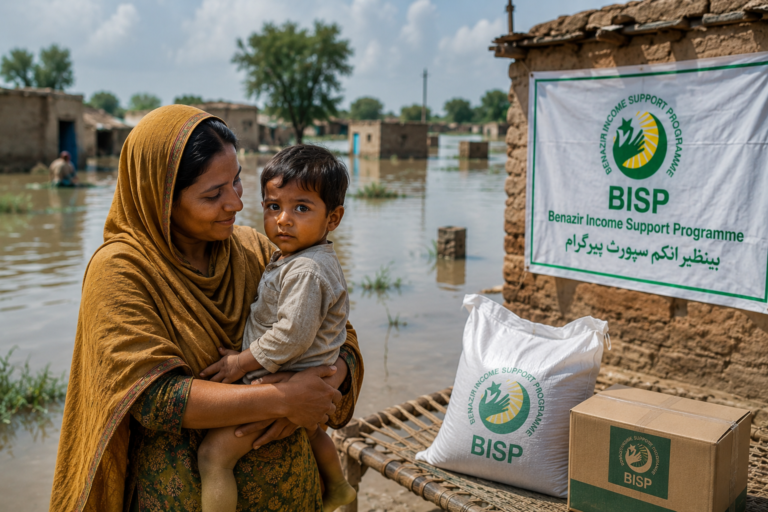
ISLAMABAD, May 07 (ABC): More than 5.46 million pregnant women and children under the age of two have benefited from the Social Protection for Health and Climate Resilience project launched in 87 flood-affected districts, according to a document available with Wealth Pakistan.
The Benazir Income Support Programme (BISP) implemented the project with financial support from the German Development Bank KfW. The initiative received a total grant of €27 million under an agreement signed on June 9, 2023.
The project aimed to strengthen Pakistan’s social protection system while improving health and nutrition support for climate-vulnerable families living in flood-hit areas.
Nutrition support for mothers and children
A major share of the funding, amounting to €18 million, was allocated to nutrition-related conditional cash transfers in the affected districts.
Under this component, eligible beneficiaries received Rs1,000 per quarter to help improve nutrition for pregnant women and children under the age of two. The financial support helped vulnerable families meet basic nutritional needs during difficult economic conditions.
The document stated that the initiative mainly targeted communities severely affected by floods and climate-related disasters.
Financial assistance during climate emergencies
The project also introduced a shock-responsive social protection mechanism to support flood-hit families during emergencies.
Under this system, affected households received financial assistance for up to two years. The mechanism ensured timely support during climate-related shocks and helped families recover from disaster-related losses.
The initiative aimed to improve the government’s ability to respond quickly to future climate emergencies through a more coordinated social protection framework.
Focus on long-term climate resilience
Besides immediate relief, the project also focused on developing adaptive social protection systems for the future.
The programme included feasibility studies, early warning mechanisms, and anticipatory action strategies to improve preparedness for climate-related disasters.
According to the document, the initiative reflected Pakistan’s growing focus on linking social protection with climate resilience. It combined emergency assistance with long-term planning to provide stronger and more sustainable support for vulnerable populations.

Govt plans 500MW floating solar project at Keenjhar Lake
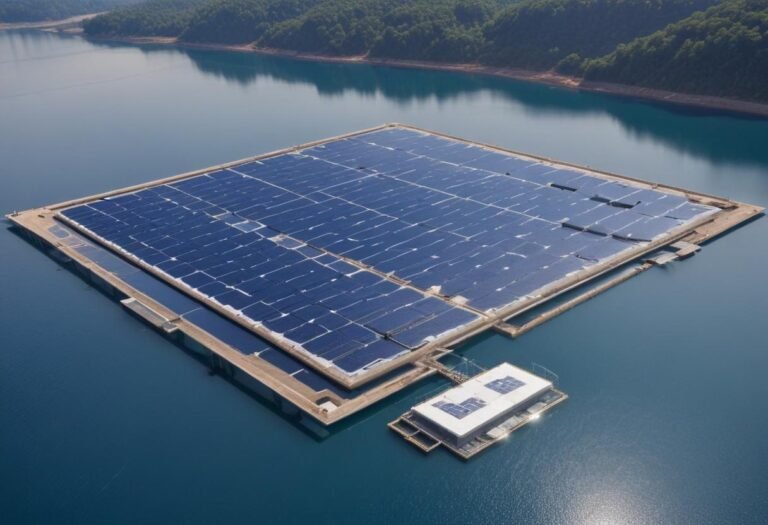
ISLAMABAD, May 6 (ABC): The government plans to develop a 500-megawatt floating solar power project at Keenjhar Lake in Sindh to increase clean energy generation and reduce dependence on imported fossil fuels.
According to documents available with Wealth Pakistan, the project carries an estimated cost of $243.63 million and is expected to generate around 861.91 gigawatt-hours of electricity annually.
The floating solar facility will supply electricity to K-Electric under a long-term Power Purchase Agreement (PPA). The project also supports Pakistan’s broader 2030 emission reduction targets and renewable energy transition goals.
Project to use water surface for solar generation
Unlike conventional solar plants, the Keenjhar Lake project will use water surfaces instead of large land areas. The approach is expected to reduce land-use pressure while improving solar panel efficiency through the cooling effect of water.
The project site is located near major industrial zones in Sindh, which will help ensure efficient transmission of electricity to high-demand areas.
Documents show the project will operate with a capacity factor of 19.6% and offer an estimated tariff of 3.98 US cents per kilowatt-hour.
EPC bidding process underway
The authorities plan to execute the project under the Engineering, Procurement and Construction (EPC) model through competitive bidding.
K-Electric has already issued a Letter of Intent (LoI) for power procurement, while the bidding process for EPC contractors is currently underway.
The total investment structure includes around $182.72 million in debt financing and $60.91 million in equity investment.
Project supports clean energy transition
The allocated funds will cover EPC development, transmission infrastructure, and operations and maintenance (O&M) requirements.
The project is also expected to create employment opportunities during both construction and operational phases, particularly in technical and engineering fields.
Officials believe the initiative will support Pakistan’s renewable energy expansion and help strengthen long-term energy security through increased use of locally generated clean electricity.
The project aligns with Sustainable Development Goals (SDGs) 7, 9, and 13, which focus on clean energy, sustainable infrastructure, and climate action.
4.27m people gain broadband access in Balochistan’s remote areas
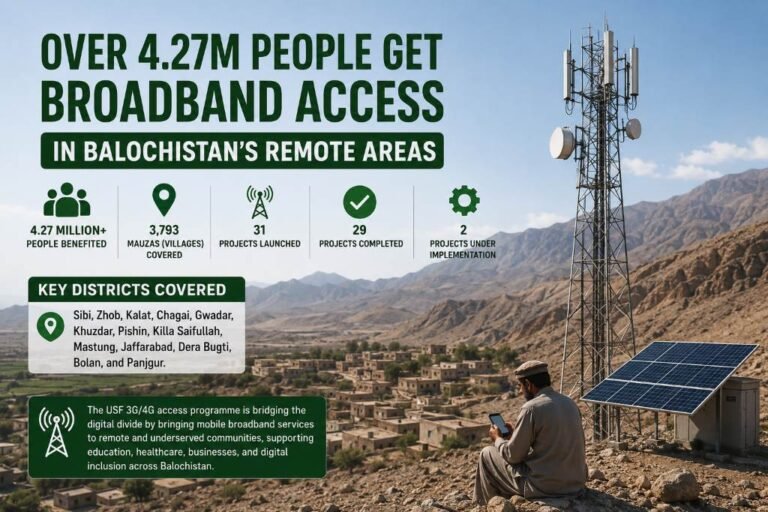
ISLAMABAD, May 6 (ABC): The government has expanded digital connectivity to 3,793 remote areas of Balochistan under the Universal Service Fund’s (USF) 3G/4G access programme, benefiting more than 4.27 million people across the province.
According to documents available with Wealth Pakistan, 31 projects have so far been launched in Balochistan under the programme. Of these, 29 projects have been completed, while two are still under implementation.
The projects cover 3,793 mauzas (villages) in several districts, including Sibi, Zhob, Kalat, Chagai, Gwadar, Khuzdar, Pishin, Killa Saifullah, Mastung, Jaffarabad, Dera Bugti, Bolan, and Panjgur.
Major districts receive broadband coverage
Among the completed projects, the Sibi lot provided broadband services to more than 423,000 people across 258 mauzas. The Zhob lot connected over 363,000 individuals in remote areas.
Similarly, the Bolan project extended connectivity to around 428,954 people, while the Mastung lot covered more than 138,945 residents.
The documents show that several projects were completed in recent years, including 2023 and 2025, indicating continued progress in expanding telecom infrastructure in underserved areas of the province.
Focus on remote and underserved areas
The USF programme aims to improve telecom access in regions where commercial operators face geographical and financial challenges.
The expansion of 3G/4G services is expected to improve communication facilities and support access to online education, healthcare, digital services, and business activities in remote districts.
Officials believe better internet connectivity can help reduce the digital gap between urban and rural populations and support broader economic and social development in Balochistan.
The initiative also forms part of Pakistan’s wider efforts to strengthen digital infrastructure and improve nationwide broadband penetration.
Pakistan targets climate-proofing 75% infrastructure by 2040
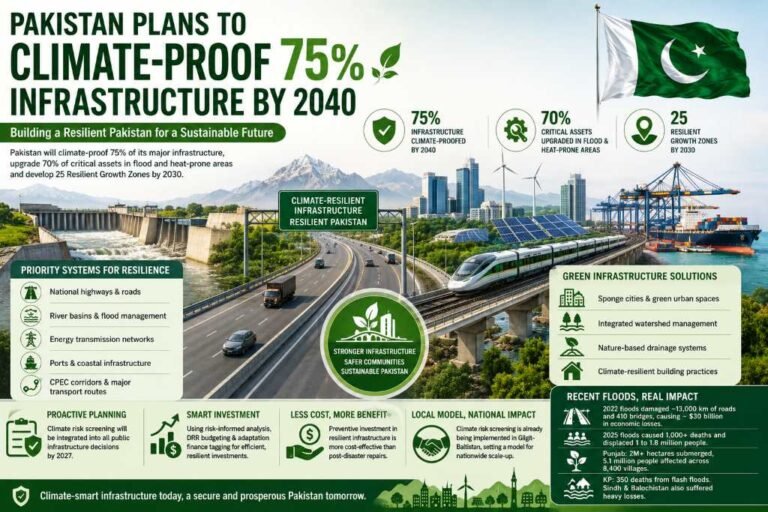
ISLAMABAD, May 05 (ABC): Pakistan plans to climate-proof 75% of its major infrastructure by 2040 and upgrade 70% of critical assets in flood and heat-prone areas. The country also plans to establish 25 Resilient Growth Zones by 2030 under a new climate resilience strategy.
According to a document available with Wealth Pakistan, the government wants to strengthen infrastructure against rising climate threats through climate-smart systems, stronger engineering standards, and better early warning mechanisms.
Climate risks expose infrastructure weaknesses
The document warns that Pakistan’s infrastructure remains highly vulnerable to floods, heatwaves, and other extreme weather events. Many roads, bridges, and energy systems were developed without proper climate risk assessments.
The growing frequency of climate disasters has increased pressure on public infrastructure. As a result, the government now plans to shift toward long-term climate-resilient planning.
Under the strategy, provincial governments will integrate climate vulnerability screening into all public infrastructure and investment decisions by 2027. Authorities will also make climate risk assessments and adaptation costing mandatory for all major infrastructure projects.
The document notes that a large share of Pakistan’s infrastructure lies in floodplains and heat-affected districts. However, it says the country can modernise these systems through improved planning and stronger construction standards.
CPEC routes among priority sectors
The strategy identifies national highways, river basins, ports, energy transmission networks, and major transport corridors as priority sectors for climate-resilient upgrades. It also highlights routes linked to the China-Pakistan Economic Corridor (CPEC).
The document says stronger infrastructure can reduce disaster losses, improve economic stability, and support sustainable growth.
At the same time, the government plans to expand green infrastructure solutions in urban and rural areas. These solutions include sponge cities, integrated watershed management, nature-based drainage systems, and climate-resilient building designs.
Focus on proactive climate planning
The strategy aims to institutionalise climate risk screening across all major development projects. Authorities plan to use climate risk-informed cost-benefit analysis, disaster risk reduction budgeting, and adaptation finance tagging to improve investment decisions.
The document stresses that preventive investment costs less than rebuilding after disasters. Therefore, Pakistan must move from reactive disaster response toward proactive climate planning.
Encouragingly, climate risk screening is already underway in Gilgit-Baltistan. The Aga Khan Agency for Habitat and the Aga Khan Rural Support Programme are implementing projects in collaboration with the government.
The document describes this initiative as a model that can support nationwide resilience-building efforts.
Recent floods highlight urgency
Recent climate disasters continue to highlight the need for resilient infrastructure across Pakistan.
The 2022 floods damaged nearly 13,000 kilometres of roads and 410 bridges. The disaster disrupted connectivity and caused economic losses estimated at around $30 billion.
The document also refers to flooding in 2025, which caused more than 1,000 deaths and displaced between one million and 1.8 million people.
Punjab faced severe impacts during recent floods. More than two million hectares of land went underwater, while 5.1 million people across 8,400 villages suffered losses.
Khyber Pakhtunkhwa recorded around 350 deaths from flash floods. Meanwhile, Sindh and Balochistan also suffered heavy damage to infrastructure, agriculture, and housing.
Despite these challenges, the document says climate-smart infrastructure offers Pakistan a pathway to reduce future disaster risks, protect livelihoods, and support sustainable economic development.
Pakistan targets doubling agri exports to China, Gulf
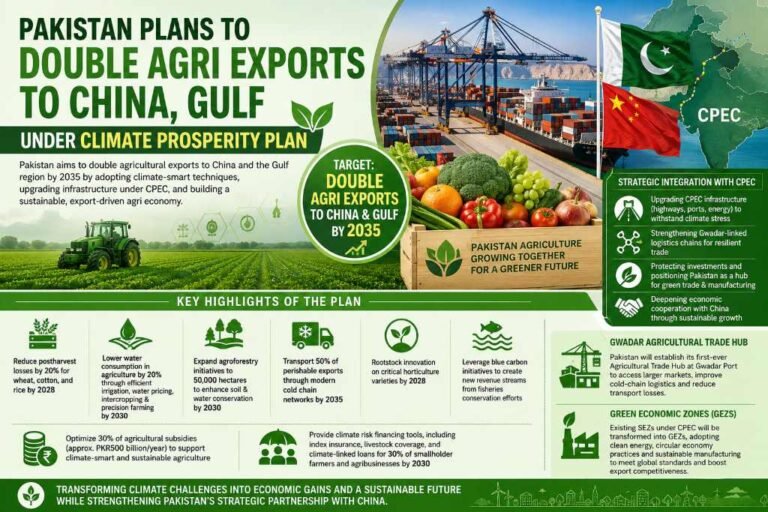
ISLAMABAD, May 05 (ABC): Pakistan plans to double its agricultural exports to China and the Gulf region by 2035 through climate-smart farming and green infrastructure initiatives under the newly unveiled Pakistan Climate Prosperity Plan.
According to an official document available with Wealth Pakistan, the plan represents a major policy shift that combines climate resilience, sustainable growth, and economic modernisation with the China-Pakistan Economic Corridor (CPEC). The strategy aims to strengthen infrastructure, improve export competitiveness, and attract environmentally sustainable investment.
Under the plan, Pakistan will upgrade key infrastructure linked to the CPEC, including highways, ports, and energy transmission systems, to withstand rising environmental and climate-related pressures. The government also plans to strengthen road connectivity and improve the resilience of Gwadar-linked logistics networks, which play a crucial role in Pakistan-China trade.
The document states that Pakistan will establish its first Agricultural Trade Hub at Gwadar Port to expand access to Chinese and Gulf markets. The project will focus on improving cold-chain logistics, reducing transportation losses, and increasing the efficiency of agricultural exports.
In addition, the government plans to convert existing Special Economic Zones (SEZs), many of which were developed under the CPEC framework, into Green Economic Zones (GEZs). These zones will promote clean energy use, circular economy practices, and environmentally sustainable manufacturing to help Pakistani products meet international environmental standards and improve export competitiveness in global markets, particularly China.
The plan says the integration of climate-smart policies with the CPEC will help protect strategic investments while positioning Pakistan as a regional hub for green manufacturing, sustainable trade, and climate-resilient industrial development.
Furthermore, the strategy outlines several agriculture-sector targets aimed at improving productivity and reducing environmental pressure. Pakistan plans to cut post-harvest losses of wheat, cotton, and rice by 20% by 2028 through improved storage and handling systems.
The government also aims to reduce water consumption in agriculture by 20% by 2030 through efficient irrigation systems, precision farming, intercropping, and improved water pricing mechanisms. At the same time, agroforestry initiatives will expand to 50,000 hectares to strengthen soil protection and water conservation efforts.
The document further highlights plans to transport 50% of perishable exports through modern cold-chain networks by 2035. It also proposes rootstock innovation for key horticulture crops by 2028 to improve crop resilience and productivity.
In the fisheries sector, the plan seeks to leverage blue carbon initiatives to create new revenue opportunities through marine and coastal conservation efforts. Meanwhile, the government plans to optimise nearly 30% of agricultural subsidies, estimated at around PKR500 billion annually, to support climate-smart agriculture and sustainable farming practices.
The strategy also includes climate risk financing tools such as index insurance, livestock coverage, and climate-linked loans for 30% of smallholder farmers and agribusinesses across the agricultural value chain by 2030.
According to the document, these measures are expected to transform climate-related challenges into economic opportunities while deepening Pakistan’s economic cooperation with China under the evolving CPEC framework.