

Pakistan becomes founding member of World AI Cooperation Organization
By Agnes Javed
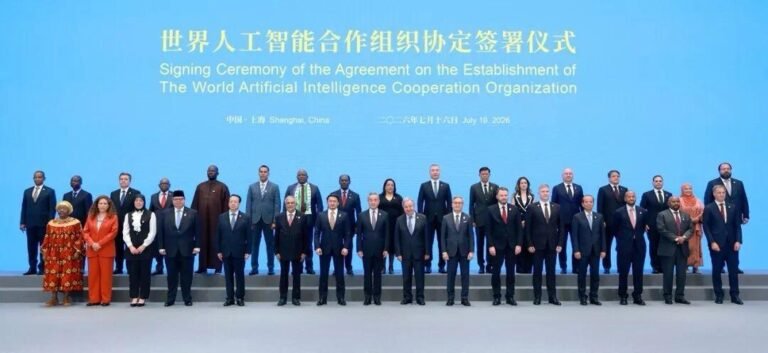
SHANGHAI, July 17 (Wealth Pakistan): Pakistan officially became a founding member of the World Artificial Intelligence Cooperation Organization (WAICO) on July 16, as Ishaq Dar, Deputy Prime Minister and Foreign Minister of Pakistan, signed the organization’s founding agreement at a signing ceremony held in Shanghai.
The signing marked the formal inauguration of the World Artificial Intelligence Cooperation Organization, an independent intergovernmental body dedicated to advancing international cooperation and global governance on artificial intelligence.
Headquartered in Shanghai, the organization acts in accordance with the purposes and principles of the UN Charter and upholds the vision of extensive consultation, joint contribution and shared benefits. Centered on a people-first approach, it strives to boost cross-border AI collaboration, promote human-centric technological progress, and ensure artificial intelligence develops in a beneficial, secure and equitable manner for the good of all mankind.
Representatives from 29 countries put their signatures on the founding agreement to become WAICO’s founding members, including Kazakhstan, Laos, Pakistan, Russia and Indonesia. António Guterres, Secretary-General of the United Nations, together with representatives from various countries and international organizations, attended the ceremony. Wang Yi, Member of the Political Bureau of the CPC Central Committee and Minister of Foreign Affairs of China, also signed the agreement on behalf of the Chinese government.
On the evening of July 16, Wang Yi met with Dar in Shanghai, where Dar was present for the World Artificial Intelligence Conference and the WAICO founding ceremony.
Wang welcomed Dar’s visit to China to attend the conference and sign the founding document on behalf of Pakistan. He noted that Pakistan’s accession to WAICO serves the long-term interests of Pakistan and its people, and adds new connotations to the China-Pakistan all-weather strategic cooperative partnership.
Describing artificial intelligence as a new frontier of technological advancement, Wang stated that as a responsible major country, China has partnered with like-minded nations to launch this organization. The initiative aims to build international consensus, carry out practical cooperation, strengthen capacity building, and enable all countries — especially those in the Global South — to share equal gains from the AI revolution while preventing a widening intelligence divide.
China stands ready to deepen coordination and cooperation with Pakistan to advance the inclusive, people-benefiting development of AI, drive economic growth in developing countries and fuel global technological innovation, Wang added.
Wang also reiterated the long-standing ironclad friendship between China and Pakistan. He called on both sides to fully implement important consensus reached by state leaders, sustain high-level exchanges, consolidate political mutual trust, expand cooperation across key sectors, step up counter-terrorism and security cooperation, and accelerate efforts to forge an even closer China-Pakistan community with a shared future.
Dar extended his congratulations to China on the establishment of WAICO, calling it a remarkable initiative with far-reaching implications for humanity and the Global South, which has won wide acclaim from the international community and fully demonstrated China’s sense of responsibility as a major power.
He said Pakistan is honored to be one of the organization’s founding members and looks forward to broadening cooperation with China in artificial intelligence and other sectors.
Dar reaffirmed Pakistan’s commitment to safeguarding the safety of Chinese personnel, institutions and projects operating in the country, pushing forward the construction of the China-Pakistan Economic Corridor, and further consolidating the all-weather strategic cooperative partnership between the two nations.
Paddy transplantation continues in Punjab amid forecast of below-normal rainfal
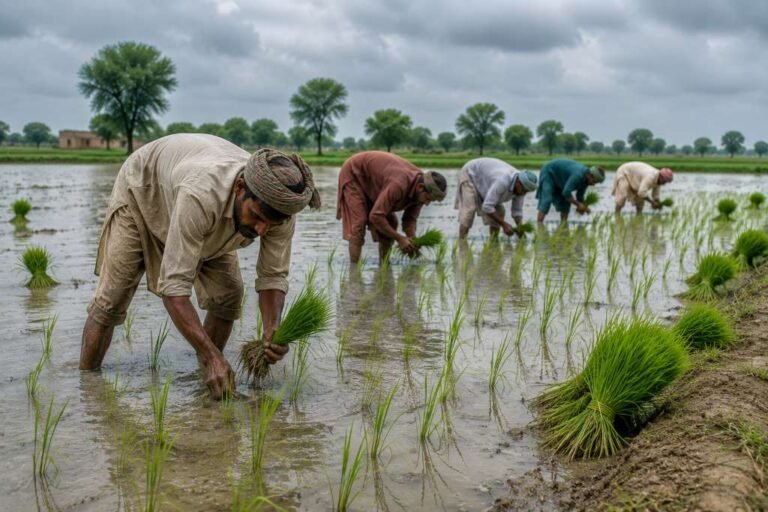
LAHORE, July 16 (ABC): Paddy transplantation is continuing across Punjab, but limited rainfall in July has slowed the planting of Basmati varieties and raised concerns among growers.
“Punjab has not received sufficient rainfall so far this month, which is essential for cultivating the water-intensive paddy crop,” said Usman Saleem, Senior Scientist at the Rice Research Institute, Kala Shah Kaku, Lahore.
Rainfall critical for paddy cultivation
The Punjab government has set a target of cultivating paddy on 5.5 million acres during the 2026-27 crop season, with expected production of 5.25 million tonnes.
Nationwide, paddy cultivation is projected to cover more than 7.4 million acres, with a production target of 9.17 million tonnes.
Talking to Wealth Pakistan, Usman Saleem said transplantation would accelerate if the province receives sufficient monsoon rainfall in the coming days.
He said timely rainfall would help Punjab achieve its cultivation target. Last year, the province exceeded its paddy cultivation target by 20%.
Fine rice varieties, including Basmati, account for about 65% of Punjab’s paddy cultivation area. Farmers grow coarse varieties, including IRRI and hybrid rice, on the remaining area.
According to Saleem, the ideal period for transplanting Basmati seedlings is July 7 to July 30, while farmers usually transplant coarse varieties between June 20 and July 7.
“If central and northern Punjab receive sufficient rainfall, the cultivation target is likely to be achieved,” he said.
PMD forecasts below-normal rainfall
According to the Pakistan Meteorological Department (PMD), most parts of the country are likely to receive below-normal rainfall during July.
“Upper Punjab, including the paddy-growing belt in the northeastern divisions, is expected to receive below-normal rainfall during the current month,” said Dr Muhammad Zaheer Babar, Chief Meteorologist.
Talking to Wealth Pakistan, he said daytime temperatures are also expected to remain above normal across the country, including Punjab.
He said these weather conditions could increase crop water requirements, affect irrigation schedules, encourage pest populations and create additional crop management challenges.
Exporters express concerns
Rice exporters have also expressed concern over the possible impact of dry weather on rice production and exports.
“Below-normal rainfall may reduce the exportable surplus of rice, which is an important source of foreign exchange earnings,” said Taufiq Ahmad Khan, former Senior Vice Chairman of the Rice Exporters Association of Pakistan.
Talking to Wealth Pakistan, he said the increasing cultivation of hybrid rice in Punjab has reduced the area under premium Basmati varieties.
He also warned that some dealers were mixing hybrid rice with Basmati, which could damage the reputation of Pakistani Basmati in international markets.
Khan urged the government to strengthen regulation of rice varieties and maintain an efficient value chain from farm to export markets.
He said stronger oversight would improve traceability and help protect Pakistan’s premium Basmati brand in global markets.
Govt plans three new projects under Rs122bn Green Pakistan Programme
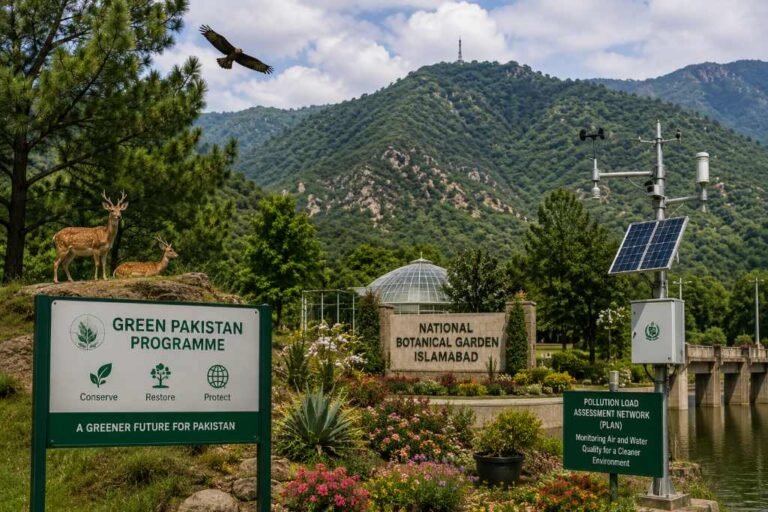
ISLAMABAD, July 15 (ABC): The federal government plans to launch three new environmental projects under the revised Upscaling of Green Pakistan Programme (UGPP) during FY2026-27.
According to documents available with Wealth Pakistan, the programme carries a total cost of Rs122.146 billion, including a federal PSDP share of Rs76.322 billion. The government has allocated Rs2.335 billion for FY2026-27.
The Ministry of Climate Change and Environmental Coordination describes UGPP as its flagship initiative for ecological restoration, biodiversity conservation and climate resilience.
Programme to strengthen natural resources
The revised programme supports large-scale afforestation, biodiversity conservation and carbon sequestration.
It also promotes climate adaptation, climate change mitigation, carbon credit generation and compliance with Pakistan’s international environmental commitments.
The project follows a cost-sharing model. The federal government will contribute about Rs76.3 billion, while provincial governments will provide around Rs45.8 billion.
The programme also includes forest restoration, promotion of non-timber forest products, carbon financing, GIS and remote sensing, institutional strengthening and environmental monitoring.
Margalla Hills conservation project
The first new initiative focuses on biodiversity conservation and landscape management in Margalla Hills National Park and its buffer zones.
The project has an estimated cost of Rs1.689 billion.
Under the plan, the government will establish a Wildlife Rescue Centre and an Urban Forestry Unit inside the national park.
These facilities will support wildlife rescue and rehabilitation, biodiversity conservation and the expansion of urban green spaces.
The Islamabad Wildlife Management Board will implement the project.
National Botanical Garden planned
The second initiative proposes the establishment of a National Botanical Garden at Bani Gala in Islamabad.
The Phase-I project carries an estimated cost of Rs800 million.
The botanical garden will conserve plant species, protect Pakistan’s natural heritage and support national and international conservation commitments.
The project includes nurseries, seed banks, herbarium facilities, research centres, thematic gardens, ecological restoration sites and visitor facilities.
The Zoological Survey of Pakistan will oversee the project.
According to the documents, the National Botanical Garden will become a leading institution for plant conservation, scientific research, environmental education and sustainable ecotourism.
Pollution monitoring network for Islamabad
The third proposed initiative is the Pollution Load Assessment Network (PLAN), with an estimated cost of Rs1 billion.
The project will establish modern infrastructure to monitor air and water pollution across the Islamabad Capital Territory.
It will also strengthen the institutional capacity of environmental authorities to support evidence-based policymaking, environmental regulation and compliance monitoring.
The Pakistan Environmental Protection Agency will implement the initiative.
Supporting climate resilience
According to the documents, the three new projects will strengthen biodiversity conservation, improve pollution monitoring and expand ecological restoration efforts.
Together, they will support Pakistan’s long-term climate resilience goals while protecting natural resources and strengthening environmental management.
KP govt to develop 12 polo grounds in Chitral
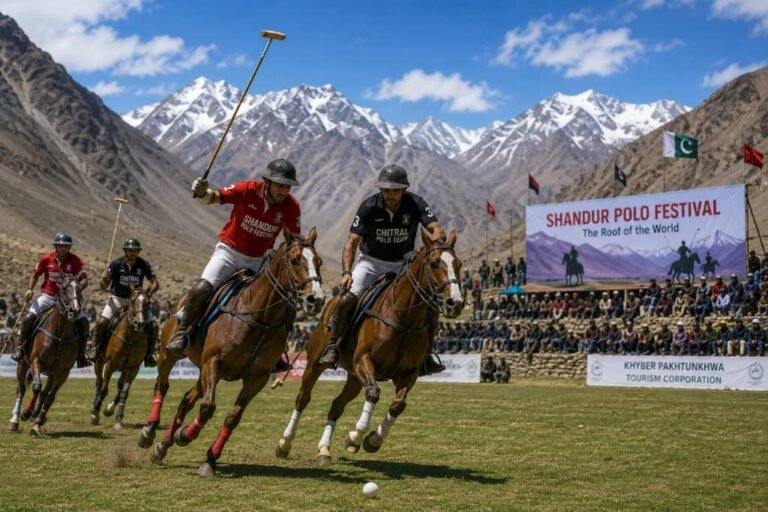
ISLAMABAD, July 15 (ABC): The Khyber Pakhtunkhwa government has approved a Rs2 billion tourism and cultural heritage project to develop and maintain 12 polo grounds in Upper and Lower Chitral, including the historic Shandur Polo Ground.
According to an official document available with Wealth Pakistan, the project aims to preserve Chitral’s traditional polo culture, promote sports tourism and create new income opportunities for local communities.
Project to strengthen sports tourism
The development of 12 polo grounds is the largest tourism-related project planned for Chitral under the scheme.
The government expects the initiative to preserve one of the region’s most important cultural traditions while attracting more domestic and international tourists.
Shandur Polo Festival remains key attraction
The Shandur Polo Festival continues to be one of Chitral’s biggest tourism events.
Authorities organise the festival at Shandur Top in collaboration with Chitral Scouts, the district administration, the police and the Gilgit-Baltistan government.
Every year, the festival generates millions of rupees for local communities through transport, accommodation, food services, temporary stalls and other tourism-related businesses.
Unlike formal club polo, traditional Chitrali polo is faster, more physical and closely linked with local festivals and community life.
Several cultural festivals included
The project document also highlights several cultural and tourism festivals across Chitral.
These include the Shandur Polo Festival, the Pre-Shandur Polo Tournament, the Qaqhlasht Festival, the Broghil Festival, the Khut Festival, the Chilam Joshi Festival, the Uchal Summer Festival and the Choimus Winter Festival.
These events play an important role in promoting Chitral’s culture and attracting visitors throughout the year.
Additional tourism projects planned
Besides the polo grounds project, the government has planned several other tourism initiatives.
These include a Tourist Facilitation and Rest Area at Booni in Upper Chitral, tourist picnic spots at Garam Chashma in Lower Chitral and Sorlaspur in Upper Chitral, and camping pod villages at Bumburait, Sorlaspur and Yarkhun Lasht.
The projects aim to improve visitor facilities and encourage longer tourist stays.
Roads and home-stay programme
The document also includes several infrastructure projects to improve access to tourist destinations.
These include the construction of a 17.1-kilometre road costing Rs1.783 billion. In addition, the Ayun-Bumburait and Zainey Pass roads have been recommended for inclusion in future Annual Development Programme (ADP) schemes.
The government has also launched the Rs300 million Mezban (Host) Tourism Programme in Upper Chitral, Lower Chitral, Upper Dir, Lower Dir and Mansehra.
The programme will support home-stay facilities by providing interest-free loans ranging from Rs1 million to Rs3 million.
Boost for local economy
According to the document, the development of new polo grounds and tourism facilities will strengthen Chitral’s tourism industry.
The initiative is expected to benefit polo players, transporters, hotel owners, shopkeepers and other small businesses while preserving the region’s unique cultural heritage.
Punjab to train 90,000 students in eight priority economic sectors by 2029
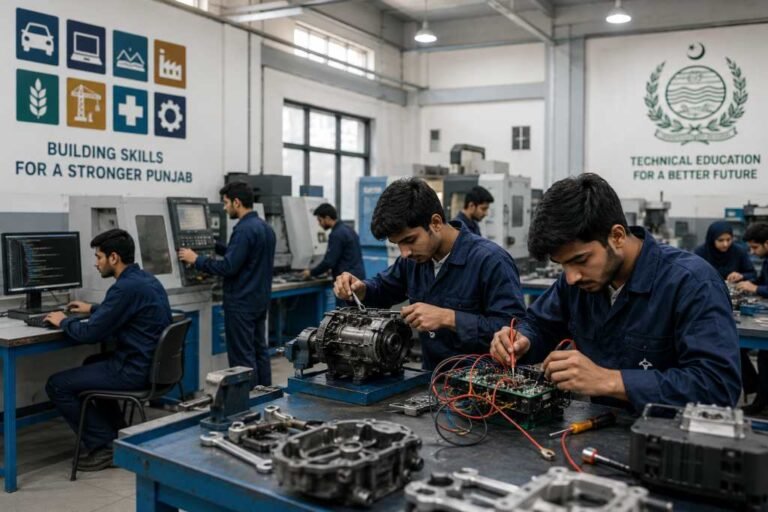
ISLAMABAD, July 13 (ABC): The Punjab government plans to train around 90,000 students in eight priority economic sectors under the Improving Workforce Readiness in Punjab Project by 2029.
According to official documents available with Wealth Pakistan, the project started in 2023 and will continue until 2029. It aims to bridge the gap between technical education and labour market demand through industry-focused training based on a skills-mapping study.
Training aligned with industry needs
The initiative seeks to replace conventional training with practical, market-oriented programmes that improve students’ employability.
Under the project, the government will upgrade 19 technical and vocational institutes into Centres of Excellence. These include 16 institutes operated by TEVTA and three managed by the Punjab Vocational Training Council (PVTC).
The upgraded institutes will provide specialised training in eight priority sectors: automotive, information and communication technology (ICT), tourism, food processing, textile, construction, healthcare and light engineering.
90,000 students to receive market-based training
A major component of the project is the provision of market-based training to about 90,000 students.
The training programmes will follow the findings of a comprehensive skills-mapping study to ensure graduates develop skills that match current labour market requirements.
The government expects the initiative to improve youth employability while supporting the growth of Punjab’s industrial and services sectors.
Stronger labour market information system
The project also includes the modernisation of Technical and Vocational Education and Training (TVET) management systems and Labour Market Information Systems.
The upgraded systems will improve the quality and timeliness of labour market data available to policymakers, training institutions and industry stakeholders.
According to the documents, better labour market information will help identify skills shortages more accurately and support the design of training programmes that reflect industry demand.
Supporting Punjab’s economic growth
Punjab’s economy requires a steady supply of skilled workers in sectors such as ICT, construction, textiles, healthcare, food processing and light engineering.
According to the documents, the workforce readiness project will strengthen the capacity of selected technical institutes while aligning vocational training with market demand. The initiative aims to create a more skilled workforce and support sustainable industrial and economic growth across the province.
Govt plans Rs2.8bn initiative to modernise Sialkot surgical instruments sector
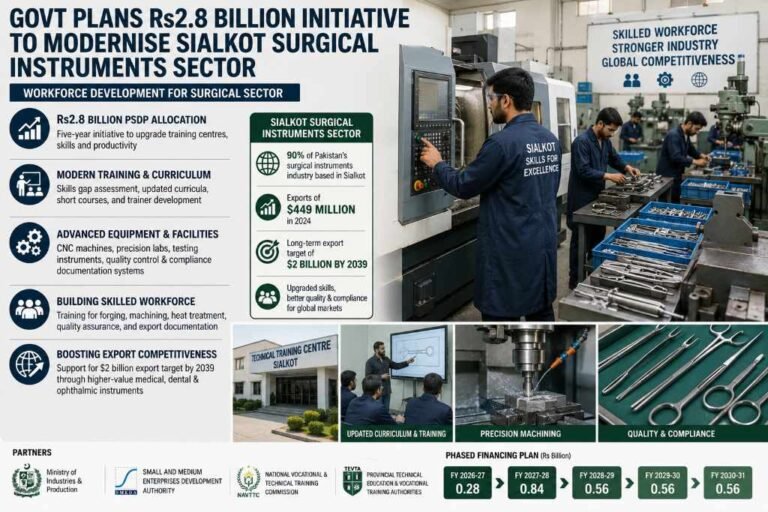
ISLAMABAD, July 12 (ABC): The government plans to launch a Rs2.8 billion workforce development initiative to modernise Pakistan’s surgical instruments sector by upgrading technical training centres in Sialkot and nearby industrial clusters.
According to documents available with Wealth Pakistan, the Workforce Development for Surgical Sector programme will be implemented by the Ministry of Industries and Production through the Small and Medium Enterprises Development Authority (SMEDA).
The National Vocational and Technical Training Commission (NAVTTC) and provincial Technical Education and Vocational Training Authorities (TEVTAs) will support the project.
Programme to upgrade workforce skills
The initiative will assess skills gaps across the surgical sector and develop industry-focused curricula.
It will also rehabilitate and expand technical training centres, provide modern training equipment, introduce short-course certification programmes and strengthen trainer development.
Supporting Pakistan’s export industry
Sialkot accounts for about 90% of Pakistan’s surgical instruments industry.
The sector exported around $449 million worth of surgical instruments in 2024, making Pakistan one of the world’s leading exporters.
However, official documents note that Pakistan still holds a limited share of the global market because of gaps in precision manufacturing, quality assurance, compliance documentation and higher-value product development.
The government aims to increase surgical instrument exports to $2 billion by 2039 by moving into higher-value medical, dental and ophthalmic products.
Modern training facilities planned
The project will conduct a detailed occupational skills assessment across the surgical instruments value chain.
Training will cover forging, CNC machining, grinding and polishing, electro-polishing, passivation, quality control and documentation.
Authorities will also develop competency-based curricula for priority trades.
The new courses will include ISO 13485 quality management principles, Medical Device Regulation (MDR/CE) awareness, compliance documentation and product traceability requirements demanded by international buyers.
Training centres in Sialkot will receive modern equipment, including precision machining laboratories, grinding and polishing workshops, quality control stations and compliance documentation facilities.
The government also plans to procure CNC machines, powder metallurgy equipment, casting technology, ultra-low-temperature quenching systems, metrology equipment, hardness testing instruments and modern quality documentation systems.
Training for workers and instructors
The programme will offer structured short courses, certification programmes and supervisory training.
Workers will receive training in forging, precision manufacturing, heat treatment, machining, metal fabrication, quality assurance and export documentation.
Both new entrants and experienced workers will benefit from the programme.
The initiative will also strengthen trainer capacity through partnerships with national technical institutions and international medical device training organisations.
Implementation and funding
The total Public Sector Development Programme (PSDP) allocation stands at Rs2.8 billion, with no foreign exchange component.
The project will run over five financial years.
The government plans to allocate Rs280 million in FY2026-27, Rs840 million in FY2027-28 and Rs560 million annually from FY2028-29 to FY2030-31.
SMEDA will coordinate project implementation, while NAVTTC will align the programme with the national skills framework.
Provincial TEVTAs will oversee training delivery in Sialkot.
Industry organisations, including the Sialkot Surgical Instruments Manufacturers Association, will help identify skills gaps, validate curricula and facilitate trainee placement.
Expected impact
According to the documents, the initiative will modernise technical training centres, introduce compliance-based curricula and increase the number of trained and certified workers.
The programme also aims to improve productivity, strengthen product quality, enhance regulatory compliance and support the long-term growth of Pakistan’s surgical instruments exports.