

Home Blog Page 13

Water-testing equipment installed in 46 labs under quality initiative

0

ISLAMABAD, Aug 16 (ABC): Water-testing equipment has been installed in 46 laboratories across Islamabad, Punjab and Khyber Pakhtunkhwa, while nine mobile laboratories have become operational under an initiative to strengthen drinking-water quality monitoring and surveillance.

According to documents available with Wealth Pakistan, the initiative has strengthened water-quality monitoring, surveillance and management systems in line with Sustainable Development Goal (SDG) 6. It has also focused on improving institutional and policy arrangements for safe drinking water.

The project has built the capacity of relevant federal and provincial institutions for water-quality monitoring and testing.

Technical staff have received training and equipment to conduct water-quality tests and surveys. The capacity-building measures aim to improve regular monitoring and enable authorities to identify water-quality problems more effectively.

Islamabad filtration plants assessed

As part of the initiative, authorities have conducted water-quality assessments at all filtration plants in Islamabad in collaboration with the Capital Development Authority (CDA).

Filters were also replaced at plants where assessments identified the need for changes.

The project has developed a country report containing recommendations to improve Pakistan’s legal and administrative systems related to SDG 6 and water resources management.

An action plan has also been prepared for smart water management in Islamabad’s water-supply system.

Federal surveillance mechanism being established

According to the documents, authorities are establishing a federal-level water-quality surveillance mechanism through comprehensive knowledge management, monitoring, evaluation and periodic reporting arrangements.

Such a mechanism did not exist before the intervention.

The new system will support Pakistan’s progress towards SDG 6, particularly Target 6.1, which focuses on universal and equitable access to safe and affordable drinking water.

The initiative is also supporting regular reporting on drinking-water quality. The reporting mechanism will help authorities improve service delivery and identify interventions needed to address water-quality problems in target areas.

Centralised monitoring system planned

The project will also support the establishment of a Centralized Quality Assessment and Monitoring System as part of broader efforts to achieve SDG 6.

According to the documents, the initiative will directly benefit marginalised communities in urban and peri-urban municipalities and local government areas in Punjab and Khyber Pakhtunkhwa.

The interventions focus on improving drinking-water quality and expanding access to safe water in the targeted areas.

The project’s implementation is also expected to pave the way for future collaboration with the Korea International Cooperation Agency (KOICA) and other national and international development partners.

Such cooperation could support additional water, sanitation and hygiene projects in other parts of the country.

Symbol of compassion

0

Tump, situated in the Makran region of Balochistan near the Iranian border, entered a new administrative era in early 2026 when it was separated from Kech and granted district status. However, many communities across this remote region continue to face social and economic difficulties, making local support and community service especially important. The district was officially established in February 2026.

In such circumstances, individuals who dedicate themselves to helping others deserve recognition. One such personality is Hammal Pirdad, a social worker and resident of Balicha Bazaar in District Tump. Known for his humility, generosity and concern for others, he has earned the respect and admiration of many people in the area.

Hammal regularly supports poor and needy people, as well as families experiencing hardship. Those who approach him for assistance rarely leave disappointed. He offers practical help according to his ability and does so without expecting recognition or anything in return.

At a time when kindness and compassion are needed more than ever, his conduct reminds us that true humanity lies in supporting others. His commitment to social welfare has made him a source of hope, particularly for people who feel helpless or overlooked.

What I admire most about Hammal is his honesty, sincerity and passion for serving the community. His actions demonstrate that even one person can bring positive change through kindness, integrity and a willingness to help.

Promoting Baloch culture and values

Hammal’s contribution is not limited to social welfare. He also encourages young people to remain connected with Baloch culture, traditions, language, hospitality and moral values.

I still remember a programme organised to celebrate Baloch Culture Day. Speaking at the event, Hammal delivered an important message: culture should not be celebrated on only one day of the year. Instead, it should be reflected in our language, behaviour, hospitality and everyday lives.

His message was simple but meaningful. Cultural identity cannot be protected through ceremonies alone. It survives when people practise its values, speak their language, respect their traditions and pass them on to the next generation.

Hammal particularly motivates young people to take pride in their identity rather than blindly imitate foreign cultures. At the same time, his teachings emphasise universal values such as humanity, dignity, honesty, generosity and respect for others.

An example for the younger generation

Hammal’s life offers an important lesson for the younger generation: success should not be measured only by personal gain. A meaningful life is also defined by how much a person contributes to the welfare of others.

Society often waits for governments, organisations or wealthy individuals to solve every problem. However, Hammal’s example shows that ordinary citizens can also make a difference. A compassionate person may not be able to eliminate every hardship, but timely assistance can transform the life of an individual or family.

As Tump begins a new chapter of administrative development, it will need roads, schools, healthcare facilities and employment opportunities. At the same time, it will also need socially responsible citizens who strengthen community bonds and assist those facing difficulties.

Hammal Pirdad represents this spirit of service. He is admired not only for his good deeds but also for his character and sincere concern for society. His efforts should inspire others—particularly young people—to participate in community welfare and preserve the values that define Baloch society.

People like Hammal remind us that compassion remains one of the strongest forces for positive change. His dedication deserves appreciation, and I hope he continues serving humanity with the same sincerity and commitment for many years to come.

KP plans Rs17.55bn initiative to strengthen local governance in merged areas

0

ISLAMABAD, Aug 15 (ABC): The Khyber Pakhtunkhwa government plans to invest Rs17.55 billion ($65 million) to strengthen local institutions and improve public service delivery in the province’s merged areas under a World Bank-backed programme.

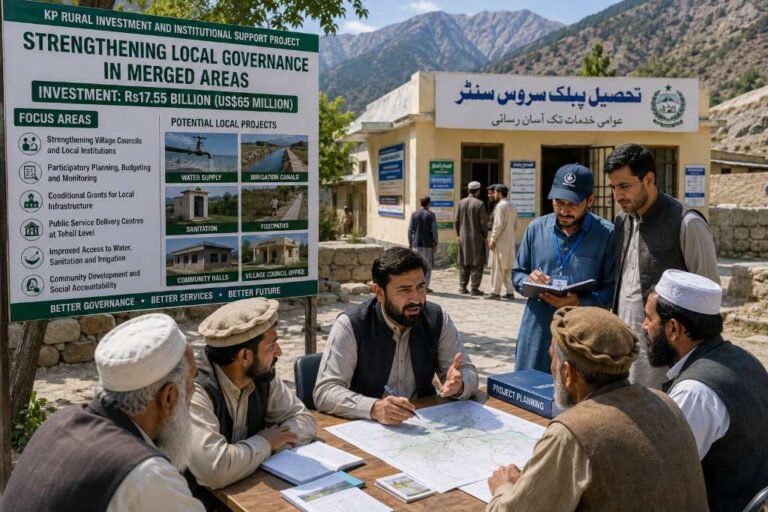
According to official documents available with Wealth Pakistan, the Institutional Development of Merged Areas initiative is one of five components of the Khyber Pakhtunkhwa Rural Investment and Institutional Support Project.

The project covers all districts of the Newly Merged Areas (NMAs) and Frontier Regions (FR) of Khyber Pakhtunkhwa. It combines investments in infrastructure, institutional development, flood response, project management and emergency response.

The Rs17.55 billion institutional development component aims to improve the government’s responsiveness to citizens. It will focus particularly on strengthening lower tiers of government and improving public service delivery.

Village councils to receive institutional support

A major part of the initiative focuses on strengthening village councils and building the capacity of local communities.

The programme will support participatory planning, budgeting and monitoring at the local level. It will also strengthen social accountability systems, community development and behavioural-change outreach.

According to the documents, village councils will receive conditional grants to finance local infrastructure priorities based on community needs.

The government will also deploy social mobilisers and provide engineering support to village councils. This assistance will help communities identify, develop and implement village-level sub-projects.

Local schemes may include water supply, sanitation and footpaths. They may also cover boundary walls, small-scale irrigation canals, community halls and village council offices.

Selected sub-projects will receive financing through conditional grants after village councils fulfil the required access conditions.

Public service delivery centres planned

The initiative also provides for the establishment or improvement of public service delivery centres at the tehsil level.

These centres will make it easier for citizens to access government services, particularly civil and vital records.

The institutional development initiative forms part of a broader five-component programme aimed at integrating the merged areas more closely with Khyber Pakhtunkhwa’s provincial systems.

Rs47.25bn earmarked for infrastructure and services

The largest component of the broader programme is Multisectoral Investments and Improved Service Delivery to Merged Areas. It carries financing of Rs47.25 billion ($175 million).

This component focuses on extending government systems to the merged areas through infrastructure investment and addressing gaps in public service delivery.

The programme covers water supply and sanitation, rural roads, agriculture and irrigation infrastructure. Authorities will direct investments towards high-priority infrastructure to improve connectivity, economic productivity and human capital outcomes.

Water and sanitation investments will focus particularly on underserved areas. These interventions will include clean drinking water, sanitation services and wastewater treatment.

Agricultural investments will support value addition and processing, diversification and productivity improvement. They will also promote better marketing and training.

Together, the institutional development and infrastructure components aim to strengthen local governance, expand access to basic services and integrate the merged areas more closely with provincial administrative and service-delivery systems.

Lining project creates 83,300 acre-feet extra storage at Keenjhar Lake

0

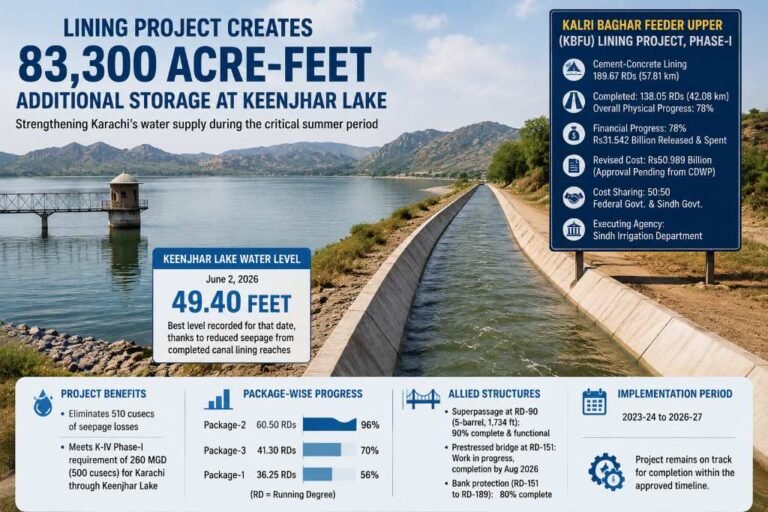
ISLAMABAD, Aug 15 (ABC): The ongoing lining of the Kalri Baghar Feeder Upper has helped create an estimated 83,300 acre-feet of additional water storage at Keenjhar Lake, strengthening the buffer available for Karachi’s water supply during the critical summer period.

According to official documents available with Wealth Pakistan, Keenjhar Lake’s water level stood at 49.40 feet on June 2, 2026. The Sindh Irrigation Department described it as the best level recorded for that date and attributed the improvement to reduced seepage from completed canal lining sections.

The PCC Lining of Kalri Baghar Feeder Upper (KBFU), Phase-I project involves cement-concrete lining of 189.67 RDs, equivalent to 57.81 kilometres. The project aims to reduce water losses and secure a reliable and sustainable bulk water supply corridor for Karachi.

So far, the project has completed lining of 138.05 RDs, or 42.08 kilometres. This has taken overall physical progress to 78%, while another 15.73 kilometres remain to be completed.

Financial progress reaches 78%

Financial progress has also reached 78%, with Rs31.542 billion released and spent on the project.

The Executive Committee of the National Economic Council (ECNEC) approved the scheme on July 19, 2023, at a cost of Rs39.943 billion.

The project’s cost has subsequently been revised to Rs50.989 billion. However, the revised cost is awaiting approval from the Central Development Working Party (CDWP).

The federal and Sindh governments are financing the project on a 50:50 cost-sharing basis, while the Sindh Irrigation Department is serving as the executing agency.

The implementation period runs from 2023-24 to 2026-27. According to the Irrigation Department, work is progressing in line with the revised schedule.

Project to reduce 510 cusecs of seepage

Once completed, the canal lining is designed to eliminate 510 cusecs of seepage losses from the water conveyance system.

The project will also help meet the K-IV Phase-I requirement of 260 million gallons per day for Karachi through Keenjhar Lake. This requirement is equivalent to around 500 cusecs.

Package-wise data shows that Package-2 is the most advanced. Contractors have completed 60.50 RDs of lining, taking physical progress on the package to 96%.

Package-1 has reached 56% physical progress, with 36.25 RDs lined. Package-3 stands at 70%, with 41.30 RDs completed.

Allied infrastructure also advances

Work is also progressing on allied infrastructure under the project.

The five-barrel, 1,734-foot superpassage at RD-90 has reached 90% completion and is already functional.

Construction of a prestressed bridge at RD-151 is also underway. The Irrigation Department has targeted completion of the bridge by the end of August 2026.

Meanwhile, bank protection works along the tail reaches between RD-151 and RD-189 have reached 80% completion.

According to the Irrigation Department, the project’s 78% financial progress is in line with its 78% physical progress.

The department maintains that the Kalri Baghar Feeder Upper lining project remains on track for completion within its approved implementation period ending in 2026-27. Once completed, it is expected to further reduce conveyance losses and strengthen the reliability of Karachi’s water supply through Keenjhar Lake.

Rs62 million development plan proposed for Kalash Valleys

0

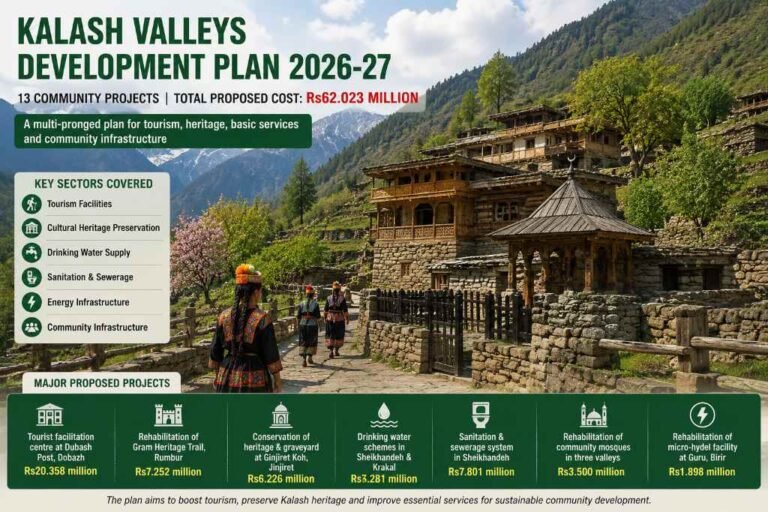
ISLAMABAD, Aug 12 (ABC): A Rs62 million development plan has been proposed for the Kalash Valleys of Chitral in Khyber Pakhtunkhwa for fiscal year 2026-27. The plan includes 13 community-level schemes covering tourism, cultural heritage, drinking water, sanitation, energy and community infrastructure.

According to the proposed Community Physical Infrastructure Works plan for FY2026-27, available with Wealth Pakistan, the schemes carry a stated total cost of Rs62.023 million.

The proposed projects cover villages across Rumbur, Birir, Bumburat, JinJiret and Dobazh valleys.

Tourism and heritage projects

The largest proposed investment is the construction and strengthening of a tourist facilitation centre at Dubash Post in Dobazh. The scheme has an estimated cost of Rs20.358 million.

Heritage preservation also forms a major part of the Kalash Valleys development plan.

The government has proposed Rs7.252 million for rehabilitation of the Gram Heritage Trail in Rumbur. The project aims to improve community access to religious sites through walkway widening, stairs, railings and stone pitching.

Another Rs6.226 million has been proposed for conservation, rehabilitation and sanitation of Kalasha-era heritage and a graveyard at Ginjiret Koh in Jinjiret.

The programme also includes smaller schemes to preserve local cultural assets.

Authorities have proposed Rs1 million for restoration and establishment of cultural stores alongside Jastakhan at Balankuru village in Rumbur. A similar project at Grambet Gole in Birir has been proposed at a cost of Rs500,000.

Community facilities included

The proposed development plan also covers community religious infrastructure.

Architectural and cultural rehabilitation of community mosques has been proposed at three locations. These include Jaw Kuru village in Birir at a cost of Rs1 million, Bumburat at Rs1.5 million and Rumbur at Rs1 million.

Basic civic facilities account for another component of the proposed investment.

A Rs6.299 million scheme has been proposed for the provision and improvement of a funeral place at Brun in Bumburat.

Drinking water and sanitation

Two safe drinking-water projects are also part of the Kalash Valleys development plan.

A Rs4.139 million water-supply scheme has been proposed at Sheikhandeh, covering Ustoi to Mikinjal. Another Rs3.742 million drinking-water project is planned at Krakal in Bumburat.

The proposed programme also earmarks Rs8.010 million for a sanitation and sewerage system in Sheikhandeh. The project aims to improve basic community infrastructure in the area.

Micro-hydel facility to be rehabilitated

The energy component includes rehabilitation of the micro-hydel power facility at Guru in Birir. The proposed project carries an estimated cost of Rs1.898 million.

The 13 proposed schemes combine tourism development and heritage conservation with improvements in drinking water, sanitation and local energy infrastructure.

The programme also seeks to improve culturally significant community spaces while addressing basic infrastructure requirements across the Kalash Valleys.

Pakistani potatoes now have export access to 36 global markets

0

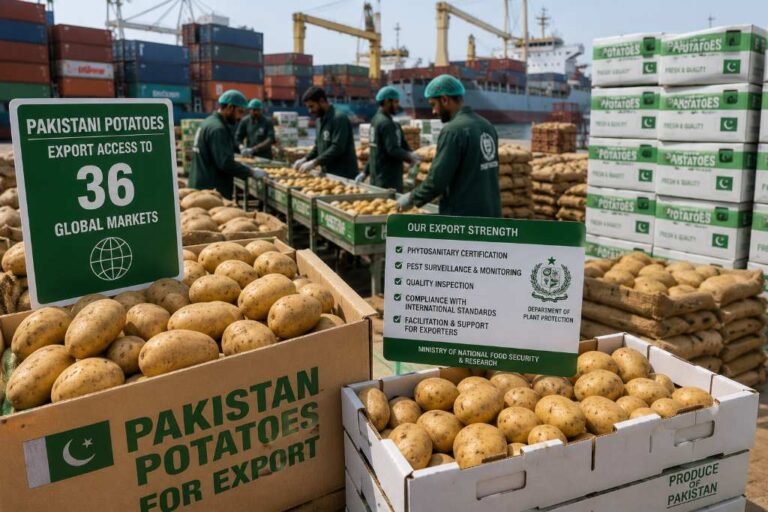
ISLAMABAD, Aug 12 (ABC): Pakistani potatoes currently have export access to 36 countries, with requirements ranging from routine phytosanitary certification to import permits and additional country-specific conditions.

According to official documents available with Wealth Pakistan, the Ministry of National Food Security and Research’s Department of Plant Protection (DPP) has compiled a Market Access and Sanitary and Phytosanitary (SPS) Compliance Matrix. The matrix covers 36 countries where Pakistani potatoes currently have export market access.

Of these markets, exporters can ship potatoes to 17 countries through routine phytosanitary certification without additional SPS conditions.

Another 10 countries require a valid import permit from the importing country’s authorities before the DPP can issue a phytosanitary certificate.

The remaining nine countries have specified additional import conditions. These include declarations on phytosanitary certificates, certification of pest-free production areas and disinfestation of packing materials and shipping containers. Exporters must also comply with other country-specific phytosanitary requirements.

Round-the-clock support for exporters

The DPP has deployed staff around the clock at major potato production, storage and processing clusters during the peak export season. These include Okara, Depalpur, Kasur and Pakpattan.

The department has also nominated a focal person to facilitate potato exports and address exporters’ grievances.

In addition, the DPP has strengthened coordination with National Plant Protection Organizations of importing countries. It is facilitating exporter registration, phytosanitary certification, pest surveillance and monitoring.

The department has also strengthened inspection and quarantine services. It continues to engage stakeholders to address market-access issues and ensure compliance with international phytosanitary standards.

Russia lifts ban on Punjab potatoes

The documents show that Russia had banned potato imports from Punjab over concerns about the alleged presence of Potato Tuber Moth and Tomato Wilt Virus.

The DPP subsequently engaged its Russian counterpart and provided scientific evidence supporting Pakistan’s phytosanitary system and pest-free status concerning the organisms of concern.

The two countries’ National Plant Protection Organizations also held bilateral consultations on the issue.

Following sustained technical and diplomatic engagement, Russian authorities accepted Pakistan’s technical justifications and supporting evidence. Russia consequently lifted the ban on potato imports from Punjab, restoring market access for Pakistani exporters.

Pakistan seeks additional markets

Pakistan is also pursuing opportunities to expand potato exports to additional international markets.

The documents state that the General Administration of Customs of China (GACC) has shown greater interest in value-added potato products. These include processed products such as potato chips and potato starch.

Such products face relatively simpler quarantine requirements and more efficient market-access procedures.

Cambodia has emerged as another positive market-access case. Pakistan submitted a market-access request in February 2026. Cambodian authorities granted access on February 28, 2026, and Pakistan subsequently circulated the decision among stakeholders.

Progress is also underway on access to the Vietnamese market. Pakistan submitted comments on Vietnam’s pest risk assessment in February 2026.

A response received in April showed that Vietnam’s Plant Production and Protection Department was working on potato market access on a priority basis, along with citrus and mango.

The documents show that Pakistan is also pursuing pest risk assessment or market-access engagement with Mexico, Japan, Argentina, Thailand, the Philippines and the European Union.

The DPP’s strategy combines country-specific SPS compliance, round-the-clock certification support and technical engagement with importing countries. It also provides a dedicated grievance-redressal mechanism to facilitate Pakistani potato exporters and expand their access to international markets.

4m rare manuscripts, records digitized under NAP modernization drive

0

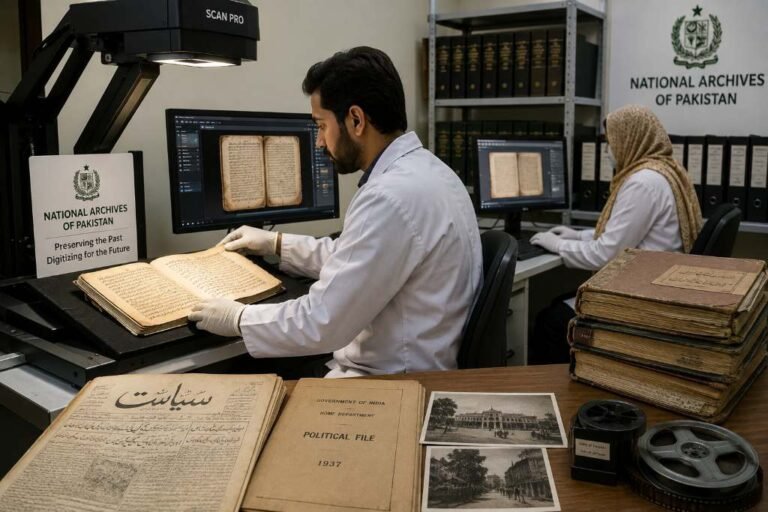
ISLAMABAD, Aug 11 (ABC): The federal government has digitized around four million historical records under a comprehensive programme to modernize the National Archives of Pakistan (NAP) and preserve the country’s documentary heritage.

According to official documents available with Wealth Pakistan, the government is implementing the initiative under the Public Sector Development Programme (PSDP) project titled “Strengthening & Modernizing National Archives of Pakistan.”

In addition to digitization, the project has restored 50,000 historical records to ensure their long-term preservation.

Rare books and manuscripts digitized

The National Archives has completed the digitization of 2.7 million pages of rare books, manuscripts, newspapers and other valuable documents.

The work marks significant progress in Pakistan’s transition towards digital preservation of historical records. It will also help protect valuable documents from deterioration and other risks associated with physical storage.

The digitization drive covers a wide range of archival material. The National Archives has also digitized photographs, microfilm rolls, audio and video recordings, and other archival holdings.

Dedicated IT Wing being established

The government is establishing a dedicated IT Wing at the National Archives to further strengthen the modernization programme.

The new digital infrastructure will improve the management and preservation of archival material while facilitating access to historical records.

The programme will also support e-governance by making archival records more accessible to researchers, policymakers and the public.

According to the documents, the modernization drive aims to protect irreplaceable historical material from physical deterioration and natural disasters.

The initiative represents a broader effort to safeguard Pakistan’s documentary legacy through modern technology, improved archival management and greater public access to historically significant records.