


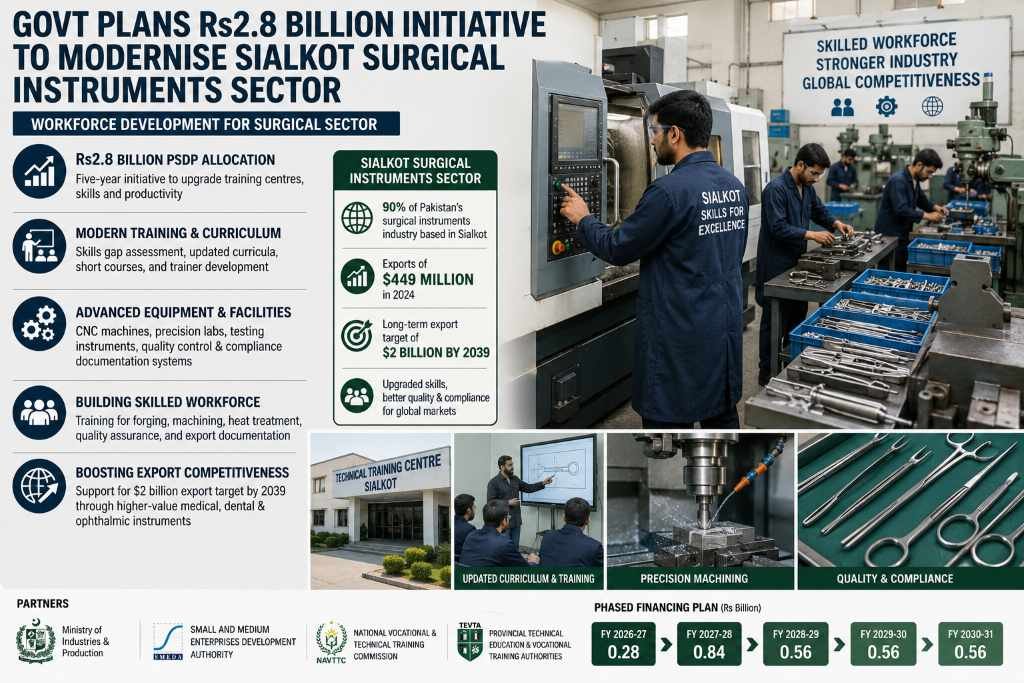
ISLAMABAD, July 12 (ABC): The government plans to launch a Rs2.8 billion workforce development initiative to modernise Pakistan’s surgical instruments sector by upgrading technical training centres in Sialkot and nearby industrial clusters.
According to documents available with Wealth Pakistan, the Workforce Development for Surgical Sector programme will be implemented by the Ministry of Industries and Production through the Small and Medium Enterprises Development Authority (SMEDA).
The National Vocational and Technical Training Commission (NAVTTC) and provincial Technical Education and Vocational Training Authorities (TEVTAs) will support the project.
Programme to upgrade workforce skills
The initiative will assess skills gaps across the surgical sector and develop industry-focused curricula.
It will also rehabilitate and expand technical training centres, provide modern training equipment, introduce short-course certification programmes and strengthen trainer development.
Supporting Pakistan’s export industry
Sialkot accounts for about 90% of Pakistan’s surgical instruments industry.
The sector exported around $449 million worth of surgical instruments in 2024, making Pakistan one of the world’s leading exporters.
However, official documents note that Pakistan still holds a limited share of the global market because of gaps in precision manufacturing, quality assurance, compliance documentation and higher-value product development.
The government aims to increase surgical instrument exports to $2 billion by 2039 by moving into higher-value medical, dental and ophthalmic products.
Modern training facilities planned
The project will conduct a detailed occupational skills assessment across the surgical instruments value chain.
Training will cover forging, CNC machining, grinding and polishing, electro-polishing, passivation, quality control and documentation.
Authorities will also develop competency-based curricula for priority trades.
The new courses will include ISO 13485 quality management principles, Medical Device Regulation (MDR/CE) awareness, compliance documentation and product traceability requirements demanded by international buyers.
Training centres in Sialkot will receive modern equipment, including precision machining laboratories, grinding and polishing workshops, quality control stations and compliance documentation facilities.
The government also plans to procure CNC machines, powder metallurgy equipment, casting technology, ultra-low-temperature quenching systems, metrology equipment, hardness testing instruments and modern quality documentation systems.
Training for workers and instructors
The programme will offer structured short courses, certification programmes and supervisory training.
Workers will receive training in forging, precision manufacturing, heat treatment, machining, metal fabrication, quality assurance and export documentation.
Both new entrants and experienced workers will benefit from the programme.
The initiative will also strengthen trainer capacity through partnerships with national technical institutions and international medical device training organisations.
Implementation and funding
The total Public Sector Development Programme (PSDP) allocation stands at Rs2.8 billion, with no foreign exchange component.
The project will run over five financial years.
The government plans to allocate Rs280 million in FY2026-27, Rs840 million in FY2027-28 and Rs560 million annually from FY2028-29 to FY2030-31.
SMEDA will coordinate project implementation, while NAVTTC will align the programme with the national skills framework.
Provincial TEVTAs will oversee training delivery in Sialkot.
Industry organisations, including the Sialkot Surgical Instruments Manufacturers Association, will help identify skills gaps, validate curricula and facilitate trainee placement.
Expected impact
According to the documents, the initiative will modernise technical training centres, introduce compliance-based curricula and increase the number of trained and certified workers.
The programme also aims to improve productivity, strengthen product quality, enhance regulatory compliance and support the long-term growth of Pakistan’s surgical instruments exports.