


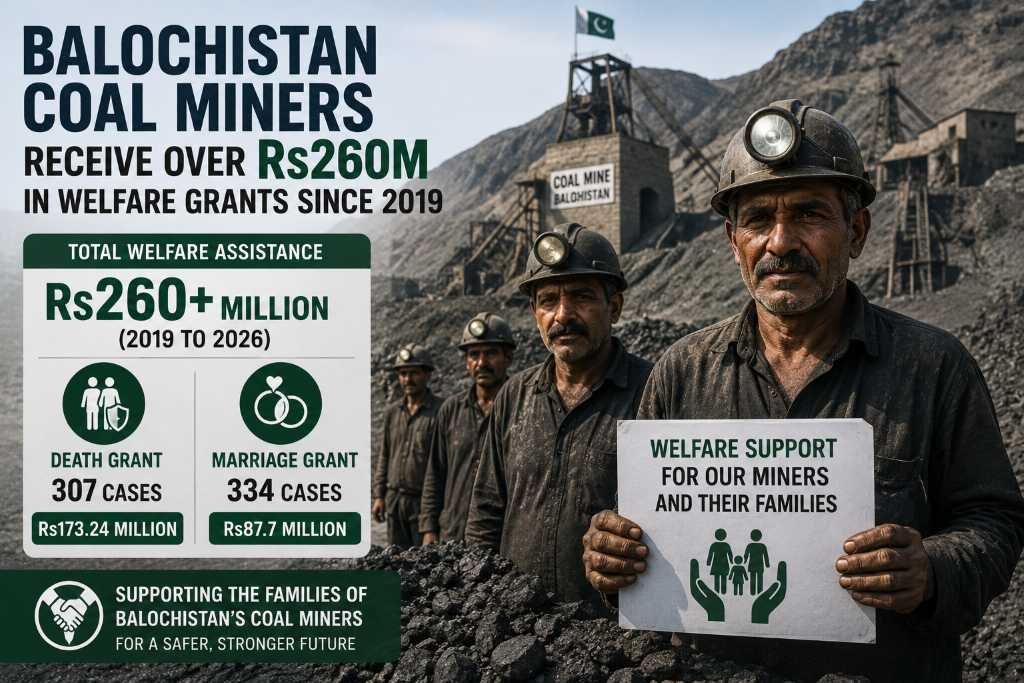
ISLAMABAD, July 10 (ABC): Balochistan’s coal miners and their families received more than Rs260 million in welfare assistance under death and marriage grant schemes between 2019 and 2026.
According to official documents available with Wealth Pakistan, the government supported 641 cases during the seven-year period. These included 307 death grant cases and 334 marriage grant cases.
The welfare payments highlight the continued need for financial support in Balochistan’s coal mining sector, where workers face difficult and hazardous working conditions.
Death grants account for largest share
Death grants accounted for the largest share of welfare assistance. Authorities disbursed Rs173.24 million in 307 cases during the period.
In FY2019-20, the government recorded two separate death grant entries. Together, they covered 136 cases with total disbursements of Rs68 million.
During FY2020-21, authorities provided Rs15.3 million in 29 cases. They disbursed Rs15 million in 25 cases during FY2021-22 and Rs14.8 million in 27 cases during FY2022-23.
In FY2023-24, the government supported 18 cases with Rs11 million.
The number of beneficiaries increased again in FY2024-25, when authorities released Rs33.94 million in 53 cases.
During FY2025-26, the government provided Rs15.2 million in 19 death grant cases.
Marriage grants support miners’ families
Marriage grants benefited 334 families during the seven-year period. Total disbursements reached Rs87.7 million.
The government released Rs3.3 million for 33 cases in FY2019-20 and Rs7.8 million for 58 cases in FY2020-21.
In FY2021-22, authorities disbursed Rs9.6 million in 48 cases. They provided Rs6.2 million in 31 cases during FY2022-23.
Marriage grant payments increased significantly in FY2023-24. During the year, 61 families received Rs23.6 million.
FY2024-25 recorded the highest number of beneficiaries, with 70 cases receiving Rs24 million.
During FY2025-26, authorities released Rs13.2 million in 33 marriage grant cases.
Need for stronger social protection
Overall, death grants accounted for about two-thirds of total welfare disbursements. These payments provided financial support to families following the loss of miners.
Marriage grants made up the remaining share and helped mining families meet household and social expenses.
According to the documents, welfare assistance has continued every year despite fluctuations in the number of cases and annual disbursements.
The figures also highlight the need to strengthen mine safety, monitoring and social protection for coal miners, whose work remains one of Pakistan’s most hazardous occupations.