


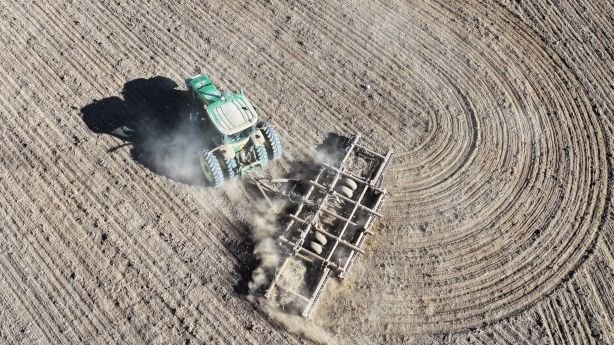

Islamabad, Jan 21 (ABC): Technology-driven farming is rapidly transforming agriculture across North America, as farmers increasingly turn to digital tools, data analytics, and automation to improve efficiency, cut costs, and boost yields.
In Saskatchewan, Canada, third-generation farmer Jake Leguee says the contrast between modern farming and the methods used by his father and grandfather could not be starker. His family farm, first established in 1956 with 640 acres, has expanded to about 17,000 acres and now produces canola, wheat, flax, and green lentils.
Leguee recalls watching earlier generations spend long hours on tractors sowing seeds and spraying crops, often working through intense heat. He says farming today is far more efficient due to technological advances that have reshaped everyday operations.
To remain competitive, Leguee has invested in precision agriculture, particularly in crop spraying. By integrating software and remote cameras with his John Deere tractor, he can identify and spray weeds with far greater accuracy while moving at about 15 miles per hour. Sensors activate individual spray nozzles only when weeds are detected, reducing the need for blanket pesticide application.
He says this targeted approach not only improves weed control but also cuts pesticide use and lowers input costs. According to Leguee, the return on investment from adopting such technologies is often high. He adds that not all innovations are expensive, noting that even low-cost digital tools, such as record-keeping apps, can significantly improve farm management.
This shift toward technology is becoming widespread. A 2024 survey by McKinsey found that 57 percent of North American farmers are likely to adopt new yield-enhancing technologies within the next two years. A separate 2022 report by the US Department of Agriculture noted that while the number of farms in the United States is declining, the remaining farms are becoming increasingly technology-intensive.
In Vermont, vegetable farmer Norah Lake says digital tools have changed how she plans and evaluates her crops. Lake, who runs Sweetland Farms, grows asparagus, tomatoes, zucchini, and also raises pastured meat. She explains that farming requires constant analysis of past performance and future planning.
Previously, she relied on Microsoft Excel spreadsheets to track yields and compare harvest data across seasons. More recently, she has shifted to specialised farm management software from a company called Tend. The platform allows her to input harvest data through a mobile app and receive insights on crop management and planning.
Lake says the software helps calculate how much seed to order based on the area she plans to harvest, streamlining tasks that were once time-consuming and manual.
Large agribusiness firms are also expanding their digital offerings. Switzerland-based Syngenta Group provides farmers with a platform called Cropwise, which uses artificial intelligence, satellite imagery, and historical weather data to guide decision-making. According to the company, the system can flag problem areas in fields, such as pest outbreaks, and draw on two decades of weather patterns to predict outcomes and risks.
Syngenta officials say such tools allow farmers to take preventive action, for example by protecting crops ahead of sudden frost events that could otherwise damage large areas.
In Europe, climate-focused agri-tech is also gaining ground. In Germany, entrepreneur Jean-Pascal Lutze has founded NoMaze, a company developing software to help farmers understand how different crops perform under varying climate conditions. The platform, set to roll out this year, is based on field tests and computer simulations that estimate water needs and yield potential.
Experts say these technologies could have wider benefits beyond the farm gate. Heather Darby, an agronomist at the University of Vermont, says improving yields and reducing crop failures could help stabilise food supplies and potentially lower prices for consumers.
She notes that when farmers are better equipped to manage risks, food systems become more reliable and secure.
Back in Saskatchewan, Leguee observes that younger farmers are generally more open to adopting new technology, while older generations may be hesitant. He argues that embracing innovation is essential, given the scale and financial stakes involved in modern farming.
He says large farms are multi-million-dollar businesses supporting multiple families, making it critical to adopt technologies that improve performance and sustainability. According to Leguee, treating farming as a business is key to ensuring long-term success and resilience.