


ISLAMABAD, June 02 (ABC): Around two million single-phase electricity consumers have registered under a QR code-based verification system introduced to ensure that power subsidies reach eligible beneficiaries, according to a media brief available with Wealth Pakistan.
Protected consumers more than double
The document shows that the number of protected consumers increased from 9.5 million in FY2022 to 21.5 million in 2026. Subsidized residential consumers now stand at 29.57 million, accounting for 86 percent of all residential electricity users in the country.
The annual subsidy for protected consumers also rose significantly. It increased from Rs199 billion in FY2022 to Rs423 billion in FY2025-26, reflecting the government’s continued support for low-income and low-consumption households.
Power subsidy bill reaches Rs527bn
According to the brief, the combined residential and agricultural electricity subsidy currently amounts to Rs527 billion. Of this total, Rs249 billion is funded directly by the government, while Rs278 billion is provided through cross-subsidies paid by other electricity consumers.
The Power Division said the objective of the QR code verification system is not to withdraw support from eligible consumers but to improve the targeting of subsidies. It said verified consumers would continue receiving assistance without interruption, while eligibility criteria would be finalized through public consultations.
Reforms help reduce sector costs
The ministry highlighted several measures that have lowered costs across the power sector. These include Rs3.5 trillion in lifetime savings achieved through the renegotiation of Independent Power Producer (IPP) contracts.
The brief also reported Rs47 billion generated through the disposal of redundant machinery belonging to government-owned generation companies. In addition, reductions in distribution company (DISCO) losses saved Rs193 billion during FY2024-25 compared with FY2023-24.
According to the document, circular debt was reduced by Rs780 billion during FY2024-25 as part of broader sector reforms.
Electricity tariffs show downward trend
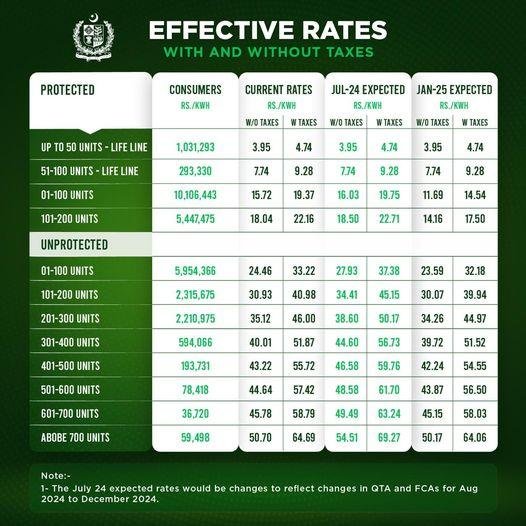
The Power Division stated that electricity tariffs declined across multiple consumer categories between March 2024 and May 2026.
The national average all-inclusive tariff fell from Rs53.04 per unit to Rs42.26 per unit, representing a 20 percent reduction.
For protected consumers using up to 200 units per month, the all-inclusive tariff declined from Rs24.07 to Rs16.56 per unit. Industrial tariffs decreased from Rs62.99 to Rs42.40 per unit, while commercial tariffs dropped from Rs76.00 to Rs70.08 per unit.
Agricultural consumers also benefited from lower tariffs, with rates falling from Rs47.56 per unit to Rs40.82 per unit during the same period.
Clean energy share set to expand
The brief said clean energy accounted for 55 percent of Pakistan’s power generation mix in 2025 and is projected to reach 90 percent by 2035.
The share of locally sourced fuel is expected to increase from 74 percent to 96 percent over the same period. As a result, the country’s annual fuel import bill is projected to decline from $2.4 billion to $0.3 billion.
Long-term planning targets reliable supply
According to the Power Division, the national grid’s installed capacity, excluding K-Electric, stood at 36,397MW in 2025. The document separately listed 12,296MW of net-metering solar capacity and 18,944MW of off-grid solar installations.
The ministry defended plans for a 26GW expansion of generation capacity, saying future planning must account for maintenance requirements, plant outages, hydrological conditions, fuel availability, solar generation variability and transmission constraints.
The brief noted that rationalization under the Indicative System Plan (ISP) 2025 removed more than 9,000MW of forced capacity additions. This decision is expected to save over $15 billion in capital investment and more than Rs400 billion annually.