


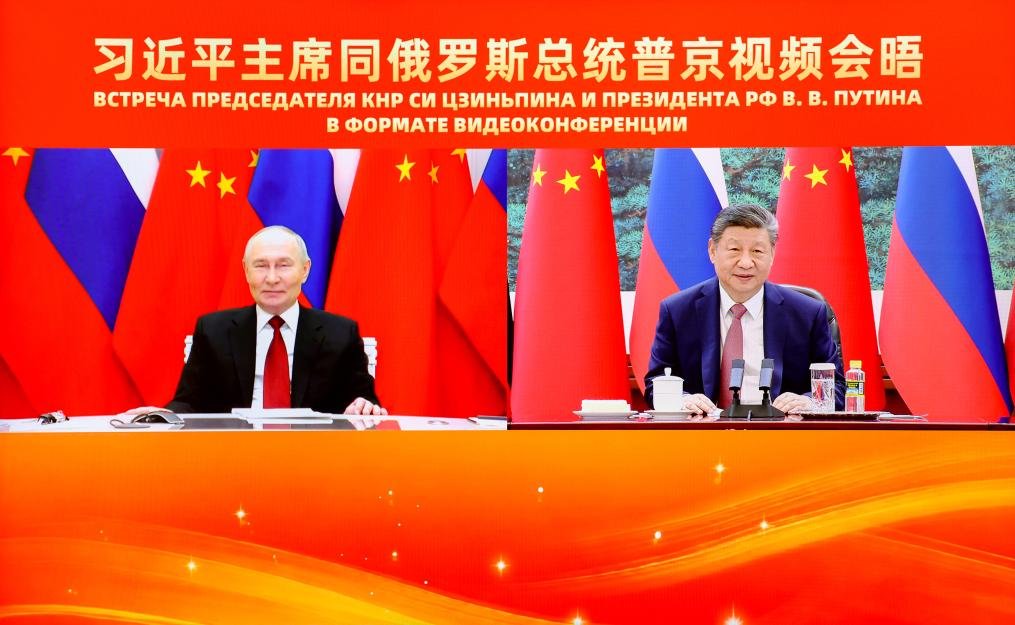

BEIJING, Feb 4 (ABC): Chinese President Xi Jinping on Wednesday called for deeper China-Russia ties and closer strategic coordination with Moscow, saying both countries should expand high-level exchanges, strengthen practical cooperation and jointly work to maintain global strategic stability amid growing international uncertainty.
Xi made the remarks during a virtual meeting with Russian President Vladimir Putin, according to the state-run Xinhua news agency.
At the start of the talks, Xi extended New Year greetings to Putin and the Russian people. He noted that the meeting coincided with the Beginning of Spring on the Chinese lunar calendar, which symbolises renewal and fresh opportunities.
On the auspicious occasion, Xi said he is ready to work with Putin to chart a new blueprint for China-Russia ties in the year ahead.
Putin, in response, wished Xi and the Chinese people a happy Spring Festival and success in all endeavours.
High-level exchanges and cooperation
Xi said both countries should increase high-level contacts and deepen pragmatic cooperation across multiple sectors, including trade, economy, education and cultural exchanges.
He recalled that the two leaders held two meetings last year that pushed China-Russia ties into a new phase of development.
According to Xi, both sides sustained strong economic and trade exchanges. They also expanded people-to-people cooperation and worked together to promote a fairer and more equitable global governance system.
As a result, he said bilateral relations continued to grow steadily despite global challenges.
New opportunities for development
Xi highlighted several milestones this year that could further strengthen China-Russia ties.
China will begin its 15th Five-Year Plan period. During this phase, Xi said Beijing will pursue higher-level opening up and share new development opportunities with partners, including Russia.
He added that this year also marks the 30th anniversary of the China-Russia strategic partnership of coordination and the 25th anniversary of the Treaty of Good-Neighborliness and Friendly Cooperation.
In addition, both sides will launch the China-Russia Years of Education to promote closer academic and cultural links.
Given these developments, Xi urged both countries to ensure that relations continue along the right path through deeper strategic coordination and stronger cooperation.
Focus on global strategic stability
Xi stressed that maintaining global strategic stability has become increasingly important.
He said the international situation has grown more turbulent since the start of the year. Therefore, China and Russia must work together to safeguard peace and stability.
As permanent members of the United Nations Security Council, both countries have special responsibilities, he added.
They should encourage the international community to uphold fairness and justice, defend the outcomes of World War II and protect the UN-centred international system and international law.
Xi said closer China-Russia ties would contribute positively to global stability and development.
Putin backs stronger partnership
Putin expressed full confidence in Russia-China ties and said the partnership remains strong and resilient.
He said both countries should continue supporting each other in safeguarding national sovereignty, security and development interests.
Putin also called for stronger education and cultural exchanges to benefit the people of both nations.
Facing a complex and fast-changing global environment, he said Russia is willing to deepen strategic coordination with China on multilateral platforms such as the United Nations, the Shanghai Cooperation Organization and BRICS.
He added that Moscow will actively support China’s hosting of the Asia-Pacific Economic Cooperation (APEC) Economic Leaders’ Meeting.
Outlook
The two leaders also exchanged views on regional and international issues of mutual concern.
Analysts say the renewed push for deeper China-Russia ties reflects efforts by both countries to enhance economic cooperation, strengthen diplomatic coordination and play a larger role in shaping global governance.
As geopolitical tensions persist worldwide, Beijing and Moscow signalled that closer coordination could help promote stability and balanced development in international affairs.