
Home Blog Page 19

119 structures rebuilt in Punjab to minimize future flood devastation

0

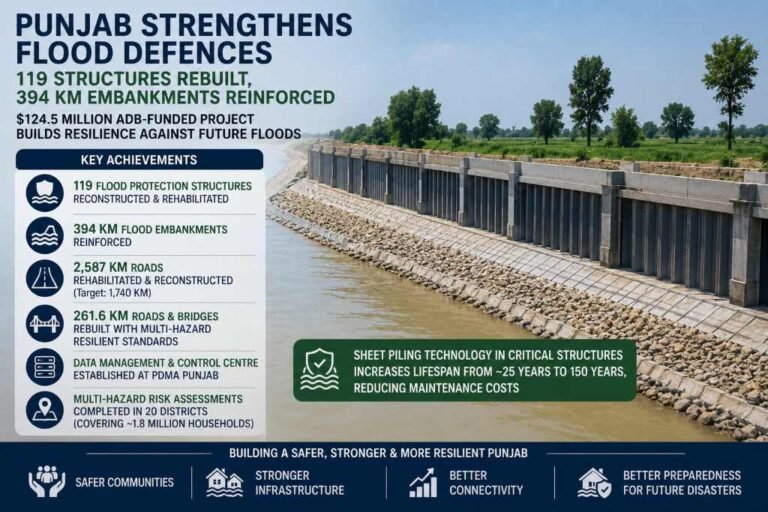
ISLAMABAD, July 12 (ABC): The Provincial Disaster Management Authority (PDMA) Punjab has reconstructed and rehabilitated 119 flood protection structures and reinforced 394 kilometres of flood embankments, strengthening the province’s defences against future floods.

According to documents available with Wealth Pakistan, the Asian Development Bank (ADB)-funded $124.5 million Flood Emergency Reconstruction and Resilience Project was launched to rebuild infrastructure damaged by severe floods.

Flood protection infrastructure strengthened

The project focused on rehabilitating roads, bridges, flood protection structures, embankments and disaster management systems.

A major achievement was the introduction of sheet piling technology in critical flood protection structures. The technology increased the expected lifespan of these structures from about 25 years to 150 years.

It also improved durability and reduced long-term maintenance costs.

Road network upgraded

The project significantly upgraded Punjab’s road infrastructure to improve connectivity and resilience.

Authorities rehabilitated and reconstructed about 2,587 kilometres of provincial highways and district roads. This exceeded the original target of 1,740 kilometres.

In addition, engineers rebuilt 261.6 kilometres of roads and bridges using multi-hazard resilient standards.

The upgraded infrastructure also includes safety features for women, children, older people and persons with disabilities.

Disaster management capacity improved

The project also strengthened Punjab’s disaster response capabilities.

Authorities established a modern Data Management and Control Centre at PDMA. The facility is equipped with high-performance servers, GIS systems, hazard mapping tools and disaster management applications.

The government also established a Data Clearing House in the Punjab Planning and Development Department.

The centre integrates and shares geospatial and disaster-related information among government departments.

Risk assessments completed

The project carried out Multi-Hazard Vulnerability and Risk Assessments in 20 districts across Punjab.

These assessments covered approximately 1.8 million households and generated important data for future disaster planning.

Building long-term resilience

According to the documents, the project has helped Punjab move beyond post-flood reconstruction.

By strengthening flood protection infrastructure, modernising disaster management systems and improving resilient transport networks, the initiative has enhanced the province’s preparedness for future floods and other natural disasters.

An Evening, Two Boys and a Kite

0

By Abdul Qadir

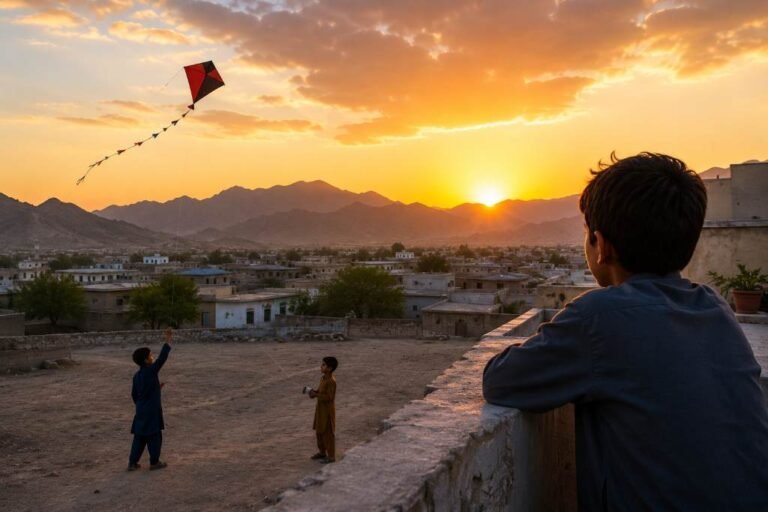
Feeling bored after spending the day at home, I went up to the roof to enjoy the fresh air and admire the evening view. The sun was still shining brightly, casting a golden glow over the surrounding mountains. I took a photo of the landscape and then stood quietly, taking in the peaceful scenery.

After a few minutes, my attention shifted downward. I noticed two little boys flying a kite. One boy held the kite in the air while the other carefully managed the spool, letting the string out and winding it back in whenever needed. They worked together silently and sincerely, without arguing or complaining.

The boy flying the kite was completely absorbed in the moment. Sometimes he let the kite soar high into the sky, and then gently pulled it back. His friend never demanded a turn or showed any sign of jealousy. Instead, he patiently supported him. After a while, the first boy happily handed over the kite, and they exchanged roles with smiles on their faces. Both were enjoying themselves, and both seemed content.

Watching them made me think about how different adults often are. Many of us spend too much time pointing out the mistakes of others while ignoring our own. We become distracted by blame, competition and ego instead of focusing on what truly matters. Children, on the other hand, often possess a simplicity and sincerity that many adults lose with age.

As I continued to watch the sky filled with colourful kites, I suddenly remembered The Kite Runner. The friendship between Amir and Hassan came back to my mind. Those two boys below reminded me of the innocence, loyalty and companionship portrayed in the novel. At that moment, I realised how deeply the book had stayed with me. A truly great book leaves an image in the reader’s mind long after the last page has been turned.

Then came a moment when one of the kites almost lost its balance and seemed ready to fall. Instead of panicking or worrying about what others might think, the boy remained focused on controlling it. He paid no attention to the people around him. His entire concentration was on the kite.

That small moment carried a lesson. Winners often distinguish themselves not because they never face difficulties, but because they remain focused despite them. The ability to ignore distractions and stay committed to a goal is valuable in every aspect of life—whether in studies, sports, writing, music or any other pursuit.

As the evening drew to a close, I remained on the rooftop, watching the children play beneath the golden sky. Their laughter, teamwork and innocence quietly transported me back to my own childhood. For a few precious moments, I was no longer just an observer; I was a child again, reliving memories carried by a kite dancing in the wind.

Balochistan coal miners receive over Rs260m in welfare grants since 2019

0

ISLAMABAD, July 10 (ABC): Balochistan’s coal miners and their families received more than Rs260 million in welfare assistance under death and marriage grant schemes between 2019 and 2026.

According to official documents available with Wealth Pakistan, the government supported 641 cases during the seven-year period. These included 307 death grant cases and 334 marriage grant cases.

The welfare payments highlight the continued need for financial support in Balochistan’s coal mining sector, where workers face difficult and hazardous working conditions.

Death grants account for largest share

Death grants accounted for the largest share of welfare assistance. Authorities disbursed Rs173.24 million in 307 cases during the period.

In FY2019-20, the government recorded two separate death grant entries. Together, they covered 136 cases with total disbursements of Rs68 million.

During FY2020-21, authorities provided Rs15.3 million in 29 cases. They disbursed Rs15 million in 25 cases during FY2021-22 and Rs14.8 million in 27 cases during FY2022-23.

In FY2023-24, the government supported 18 cases with Rs11 million.

The number of beneficiaries increased again in FY2024-25, when authorities released Rs33.94 million in 53 cases.

During FY2025-26, the government provided Rs15.2 million in 19 death grant cases.

Marriage grants support miners’ families

Marriage grants benefited 334 families during the seven-year period. Total disbursements reached Rs87.7 million.

The government released Rs3.3 million for 33 cases in FY2019-20 and Rs7.8 million for 58 cases in FY2020-21.

In FY2021-22, authorities disbursed Rs9.6 million in 48 cases. They provided Rs6.2 million in 31 cases during FY2022-23.

Marriage grant payments increased significantly in FY2023-24. During the year, 61 families received Rs23.6 million.

FY2024-25 recorded the highest number of beneficiaries, with 70 cases receiving Rs24 million.

During FY2025-26, authorities released Rs13.2 million in 33 marriage grant cases.

Need for stronger social protection

Overall, death grants accounted for about two-thirds of total welfare disbursements. These payments provided financial support to families following the loss of miners.

Marriage grants made up the remaining share and helped mining families meet household and social expenses.

According to the documents, welfare assistance has continued every year despite fluctuations in the number of cases and annual disbursements.

The figures also highlight the need to strengthen mine safety, monitoring and social protection for coal miners, whose work remains one of Pakistan’s most hazardous occupations.

Govt to spend Rs299m on expanding cellular services in AJK, GB

0

ISLAMABAD, July 10 (ABC): The government plans to further expand cellular services in Azad Jammu and Kashmir (AJK) and Gilgit-Baltistan (GB). It has proposed an allocation of Rs298.875 million for FY2026-27 to continue the project.

According to official documents available with Wealth Pakistan, the Expansion of Cellular Services in AJK and GB Phase-IV project started in 2024 and is scheduled for completion in 2027. The total project cost stands at Rs1.997 billion.

Project nears completion

The project has achieved 90% physical progress and 85% financial progress.

So far, the government has spent Rs1.698 billion. It has proposed allocating the remaining Rs298.875 million during FY2026-27 to complete the project.

Under the initiative, authorities will install 28 essential cellular sites across AJK and GB along with the required civil infrastructure.

The project aims to improve mobile connectivity, expand 4G coverage and strengthen communication services in remote mountainous areas where reliable telecom services remain limited.

4G services expand across remote areas

According to the progress report, contractors have completed civil works at 23 sites.

Authorities have also extended power supply to all 23 locations.

In addition, engineers have commissioned 4G cellular equipment at these sites, improving mobile broadband services in the targeted areas.

Work is also underway to dig trenches and lay 50 kilometres of optical fibre cable. The new fibre network will strengthen backhaul connectivity and improve network reliability.

Improved connectivity to support development

The expanded network is expected to benefit local communities, students, businesses, tourists, emergency services and public institutions.

Better cellular coverage will also support online education, telemedicine, e-commerce, tourism promotion and disaster response across AJK and GB.

According to the documents, the project forms part of the government’s broader effort to bridge the digital divide by extending modern telecom infrastructure to geographically challenging and underserved regions.

Once completed, the initiative will provide more reliable cellular and broadband services to remote communities throughout AJK and Gilgit-Baltistan.

Sindh rehabilitates 141 farm-to-market roads across 19 districts

0

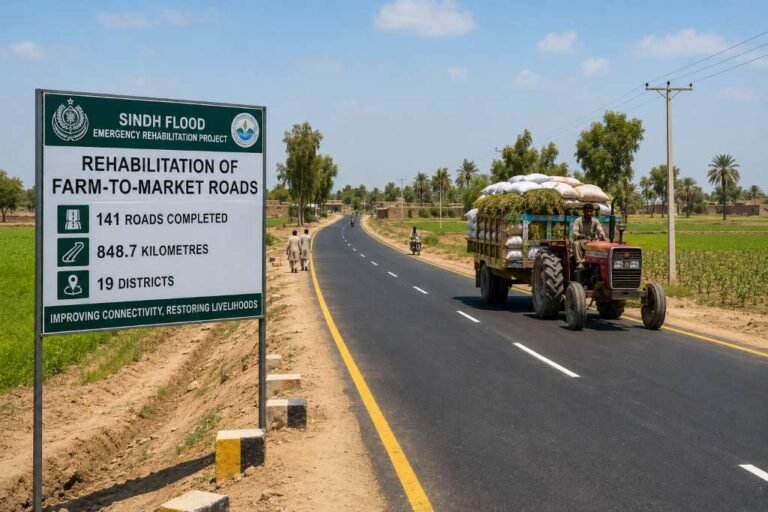
ISLAMABAD, July 09 (ABC): Sindh has completed the rehabilitation of 141 flood-hit farm-to-market roads covering 848.7 kilometres across 19 districts under the Sindh Flood Emergency Rehabilitation Project.

According to official documents available with Wealth Pakistan, the completed road network will restore mobility, improve market access and strengthen rural connectivity in flood-affected areas.

Roads restored across 19 districts

The rehabilitated roads cover Jamshoro, Dadu, Naushahro Feroze, Thatta, Sujawal, Hyderabad, Matiari, Tando Allahyar, Badin, Tharparkar, Sanghar, Mirpurkhas, Shaheed Benazirabad, Larkana, Umerkot, Khairpur, Shikarpur, Kambar Shahdadkot and Sukkur.

The road component had a completion deadline of December 2027. However, official records show that authorities have already completed the entire package.

The restored road network is expected to benefit around five million people, both directly and indirectly. It will improve access to farms, markets, schools, healthcare facilities and local commercial centres.

Project delivers wider rehabilitation gains

The documents also highlight broader progress under the Sindh Flood Emergency Rehabilitation Project.

So far, the project has benefited 2.420 million people against an overall target of 5.3 million.

Women account for 1.171 million beneficiaries, compared with the overall target of 2.650 million.

In addition, the project has benefited 428,000 households against the target of 600,000.

Authorities have also rehabilitated 205 kilometres of embankments using improved designs, compared with the target of 250 kilometres.

Meanwhile, rehabilitation work has restored 157,000 hectares of land against the overall target of 180,000 hectares.

Better connectivity to support rural economy

The completion of farm-to-market roads marks an important step in Sindh’s post-flood recovery.

Improved rural roads reconnect villages with markets and reduce transport costs. They also help farmers move crops and livestock more efficiently while improving access to schools, healthcare facilities and other essential services.

According to the documents, stronger road connectivity will support agriculture, encourage small businesses and create better economic opportunities for rural communities.

Pakistan developing high-yielding, heat-tolerant tomato varieties

0

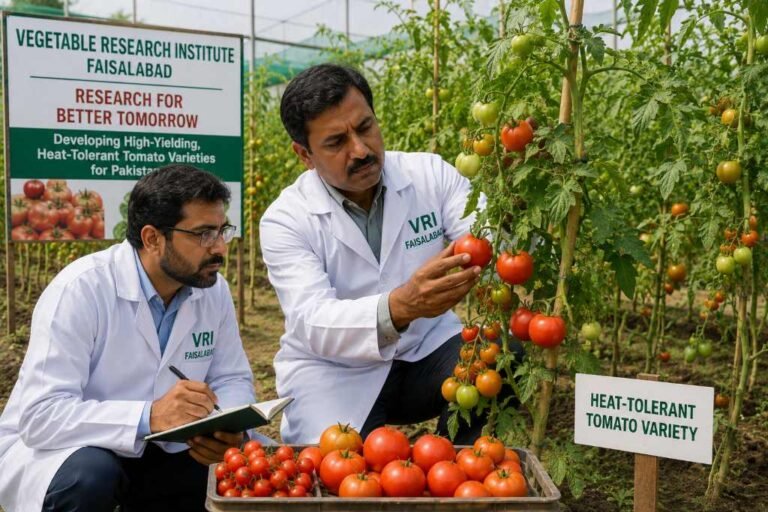
LAHORE, July 8 (ABC): Scientists at the Vegetable Research Institute (VRI), Faisalabad, are developing high-yielding, heat-tolerant tomato varieties to help reduce recurring tomato shortages in Pakistan.

“We are currently developing hybrid tomato varieties that can withstand high temperatures and resist viral diseases,” said Ghazanfar Hammad, Principal Scientist at VRI, Faisalabad.

Talking to Wealth Pakistan, he said the institute expects to release the new varieties commercially within the next two to three years.

New varieties to ensure stable supply

The researchers are developing the new varieties for cultivation during relatively moderate temperatures. This approach aims to ensure a more consistent tomato supply and reduce shortages during lean production seasons.

Ghazanfar Hammad said VRI is also developing local cherry tomato varieties. At present, gardeners mainly grow cherry tomatoes from imported seed.

“The local cherry tomato varieties will offer Pakistani consumers tomatoes with different tastes, colours and sizes,” he said.

Weather disrupts tomato production

According to Ghazanfar Hammad, tomato demand remains stable throughout the year. However, production fluctuates because of seasonal and weather-related factors.

These fluctuations often cause shortages and sharp price increases. Punjab, which contributes only about 20% of Pakistan’s total tomato production, is particularly affected.

Pakistan produces around 4.2 million tonnes of tomatoes every year. However, the country consumes almost the entire crop as fresh produce because the tomato processing industry remains underdeveloped.

Punjab grows tomatoes mainly in Muzaffargarh, Khushab, Sheikhupura, Multan, Faisalabad, Vehari, Khanewal and Gujranwala. The province supplies the market from April to June.

From June to November, Khyber Pakhtunkhwa and Balochistan meet most of the country’s demand. Sindh supplies tomatoes from December to April.

However, extreme weather events and floods frequently disrupt production and create severe market shortages, Ghazanfar Hammad said.

Imports help bridge supply gap

Vegetable traders said Pakistan usually imports tomatoes from neighbouring countries, especially Iran and Afghanistan, to bridge the gap between domestic production and market demand.

“This year, Pakistan could not import tomatoes from either country, which caused a sharp increase in prices,” Saddam Athar Khan, Secretary General of Anjuman-e-Tajiran, Badami Bagh Vegetable Market, told Wealth Pakistan.

He said tomato prices climbed to as high as Rs350 per kilogram in June.

He expressed hope that high-yielding and off-season tomato varieties would reduce import dependence and help stabilise prices.

Processing can reduce post-harvest losses

Food technologists say tomatoes are highly perishable, making long-term storage difficult.

“The best way to ensure tomato availability during lean months is to preserve tomatoes as paste, chutneys or ketchup,” said Dr Ahmad Din, Assistant Professor at the National Institute of Food Science and Technology, Faisalabad.

Talking to Wealth Pakistan, he said processors should boil, peel and remove the seeds from tomatoes during the glut season, particularly in April. They should then convert the tomatoes into paste, add a suitable preservative and store the product at about four degrees Celsius.

“You can use the preserved tomato paste throughout the year in different dishes or further process it into ketchup and other products,” he said.