


Balochistan completes 4km desilting of Pat Feeder Canal
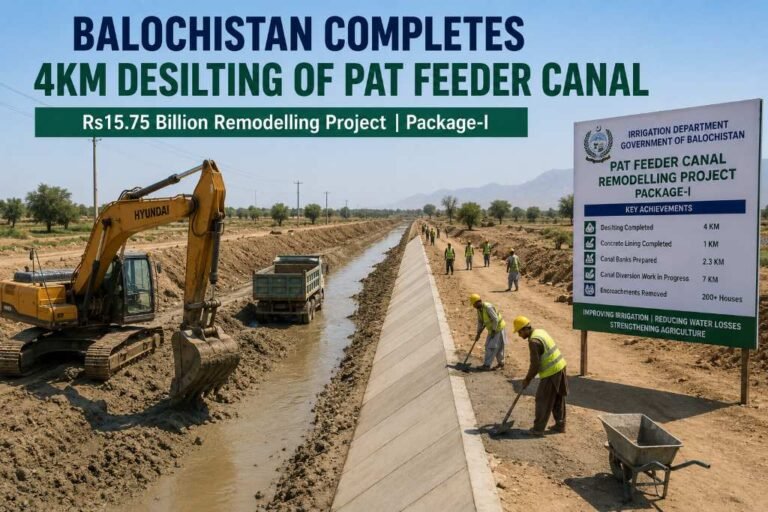
ISLAMABAD, Aug 20 (ABC): Balochistan has completed desilting over a four-kilometre stretch of the Pat Feeder Canal as work advances on Package-I of the canal system’s remodelling project.
According to documents available with Wealth Pakistan, the Irrigation Department of Balochistan is implementing Package-I of the Remodelling of Pat Feeder Canal System at a contract cost of Rs15.750 billion.
The documents show that workers have completed desilting over four kilometres and removed obstacles from the canal bed.
Concrete lining has also been completed over a one-kilometre stretch. Meanwhile, workers have prepared canal banks over 2.3 kilometres.
Canal diversion work is currently underway over another seven-kilometre stretch.
Preparatory works completed
The project has also made progress on several preparatory activities required for the main construction works.
According to the documents, authorities have completed the joint survey and pre-construction survey.
The project has also provided initial accommodation facilities, established laboratories and issued drawings for its main components.
Authorities have completed the land acquisition survey, while the award process is currently underway.
More than 200 houses identified as encroachments within the canal’s right-of-way have also been demolished to clear the area for project works.
Rs15.75bn package targets canal improvement
The ongoing activities form part of Package-I of the broader Remodelling of Pat Feeder Canal System.
The Pat Feeder Canal plays an important role in supplying irrigation water to agricultural areas of Balochistan.
The remodelling project aims to improve irrigation efficiency and reduce water losses across the canal system. It also seeks to provide a more reliable water supply to agricultural land.
Canal lining can help reduce seepage, while desilting improves water-carrying capacity by removing accumulated sediment from the canal bed.
Once completed, the Pat Feeder Canal remodelling project is expected to improve water management and support agricultural productivity in Balochistan.

Govt plans 400 ponds, mini-dams for drought-prone areas
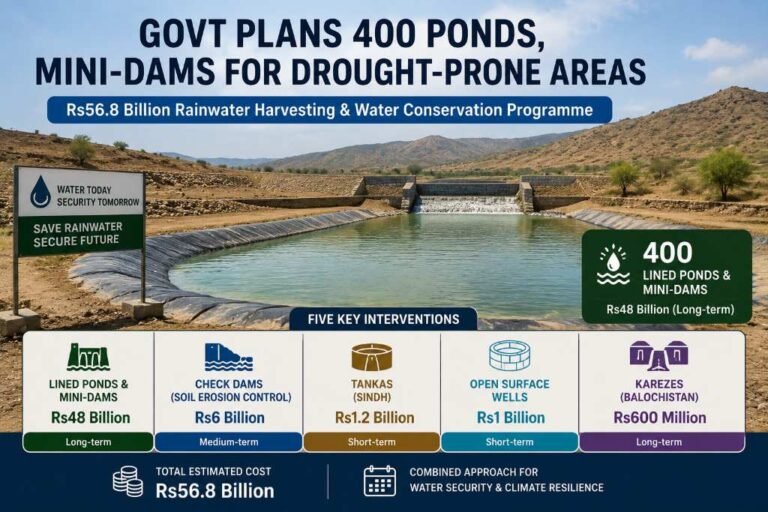
ISLAMABAD, Aug 19 (ABC): The government has proposed constructing 400 lined ponds and mini-dams in drought-prone areas at an estimated cost of Rs48 billion under a broader plan to expand rainwater harvesting and water conservation infrastructure.
According to documents available with Wealth Pakistan, the Ministry of Climate Change and Environmental Coordination has proposed five interventions with a combined estimated cost of Rs56.8 billion.
The proposed measures cover lined ponds and mini-dams, check dams, indigenous rainwater reservoirs, open surface wells and traditional karezes.
The government has divided the interventions into short-, medium- and long-term measures based on their proposed implementation timeframe.
Rs48bn proposed for ponds, mini-dams
The construction of 400 lined ponds and mini-dams represents the largest component of the proposed programme.
The ministry has estimated the intervention at Rs48 billion, accounting for around 85% of the total proposed expenditure of Rs56.8 billion.
Authorities have categorised the construction of ponds and mini-dams as a long-term measure.
These structures would help capture and store rainwater in drought-prone areas, increasing the availability of water during dry periods.
Check dams to reduce soil erosion
The ministry has also proposed Rs6 billion for the construction of check dams.
Authorities have placed the intervention in the medium-term category.
Check dams can slow the movement of rainwater, reduce soil erosion and support groundwater recharge while retaining water in areas affected by seasonal rainfall.
Another Rs1.2 billion has been proposed for the development of tankas in Sindh.
Tankas are indigenous rainwater reservoirs traditionally used to collect and store water in arid areas. The government has classified the proposed intervention as a short-term measure.
Surface wells, karezes also included
The proposals include Rs1 billion for the excavation of open surface wells in water-stressed areas.
The ministry has also placed this intervention in the short-term category.
In Balochistan, Rs600 million has been proposed for the excavation, lining and cleaning of karezes.
Karezes are traditional underground water channels that have historically supported communities and agriculture in arid areas of Balochistan. Authorities have categorised the proposed rehabilitation work as a long-term measure.
Together, the five interventions carry an estimated cost of Rs56.8 billion.
Under the proposed implementation timeframe, tankas and open surface wells fall in the short-term category. Check dams have been classified as a medium-term measure.
The 400 lined ponds and mini-dams, along with excavation, lining and cleaning of karezes, have been placed in the long-term category.
The proposed programme combines modern and traditional water-management approaches to improve rainwater harvesting, conserve available water and strengthen water security in drought-prone areas.
Sindh, KP rainwater projects benefit 67,000 people, 98,000 livestock
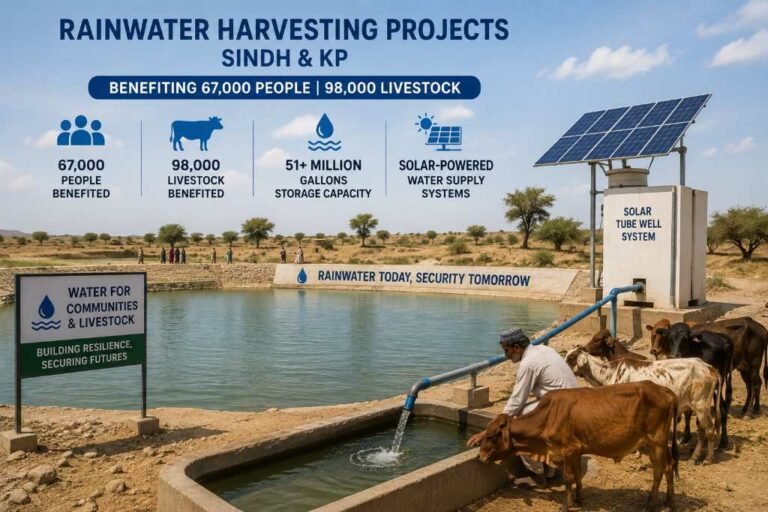
ISLAMABAD, Aug 19 (ABC): Rainwater harvesting projects in water-stressed areas of Sindh and Khyber Pakhtunkhwa are providing water access to around 67,000 people and 98,000 livestock through storage ponds, groundwater recharge and solar-powered supply systems.
According to documents available with Wealth Pakistan, the initiatives focus on drought-prone and water-scarce communities in the Thar Desert and Kohat-Hangu areas.
The projects aim to capture and store rainwater while strengthening groundwater resources. They also provide alternative water supplies for communities and livestock in areas where conventional water infrastructure remains difficult to establish.
Thar ponds store 35.21 million gallons
In the Thar Desert of Sindh, authorities have established a network of 10 rainwater harvesting ponds with a combined storage capacity of 35.21 million gallons.
The project is providing water access to approximately 46,000 people and 70,000 livestock.
Communities use the stored rainwater for domestic and livestock needs, providing an important alternative water source in the arid region.
The Thar initiative also includes a solar-powered tube well system. It supplies water to around 3,000 livestock through 48 tanks each day.
The combination of rainwater storage and solar-powered groundwater pumping aims to improve water availability while reducing dependence on conventional energy sources.
Kohat-Hangu projects benefit 21,000 people
In Khyber Pakhtunkhwa, rainwater harvesting ponds have been developed at seven sites across Kohat and Hangu with support from UNICEF.
These projects have a combined storage capacity of 16 million gallons and are benefiting around 21,000 people and 28,000 livestock.
The KP initiative extends beyond the storage of rainwater. It uses gabion structures and rainwater harvesting ponds to increase groundwater recharge and strengthen local water resources.
The programme also supports tube wells operated by the Public Health Engineering Department and dug wells used by local communities.
These interventions aim to strengthen existing water sources and improve their long-term sustainability.
Community-based water management expands
Together, the Thar and Kohat-Hangu projects have developed rainwater storage capacity of more than 51 million gallons.
The interventions reflect an increasing focus on decentralised and community-based water management in areas facing water scarcity.
Rainwater harvesting ponds can capture seasonal rainfall for later use, while groundwater recharge structures help replenish underground water resources.
Solar-powered pumping systems can further improve access to water in remote areas where electricity supplies remain limited.
The combination of rainwater harvesting, groundwater recharge and solar-powered water systems could provide a relatively low-cost model for improving water security in other water-stressed communities across Pakistan.
KP spends Rs13bn on post-flood irrigation rehabilitation
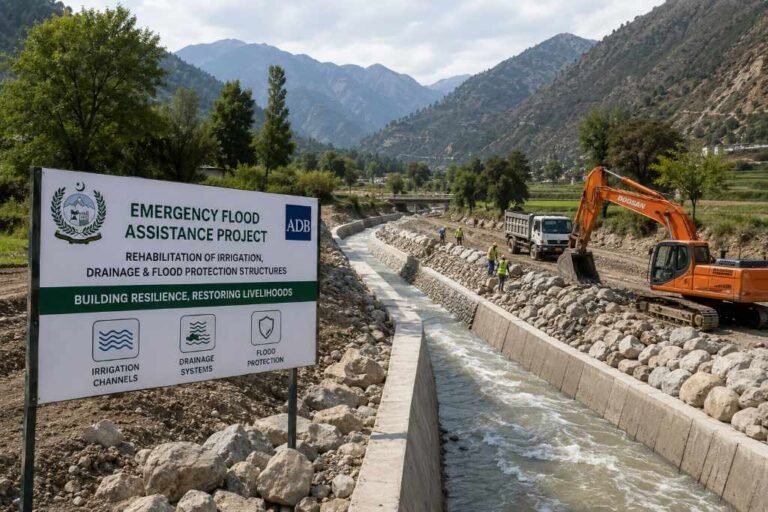
ISLAMABAD, Aug 18 (ABC): The Khyber Pakhtunkhwa government has spent Rs12.984 billion on rehabilitating flood-damaged irrigation channels, drainage systems and flood-protection structures across the province.
According to documents available with Wealth Pakistan, the Asian Development Bank-backed Emergency Flood Assistance Project covers 143 rehabilitation and reconstruction works in flood-affected areas.
These include 79 irrigation, headworks and drainage schemes and 64 flood-protection works.
The project involves rehabilitation of 91.40 kilometres of irrigation channels and 262km of drains and flood-carrier channels. It also covers 67.90km of flood-protection infrastructure.
The Irrigation Department is implementing the programme across several flood-affected areas. These include Swat, Malakand, Charsadda, Nowshera, Peshawar, Dir, Chitral, Bannu and Dera Ismail Khan.
Spending reaches Rs12.984bn
According to the project’s financial data, the foreign-funded component is valued at Rs13.2 billion. Cumulative expenditure under this component has reached Rs12.693 billion.
The local component carries financing of Rs1.8 billion, against which Rs291 million has been spent.
Together, the two components bring the total project cost to Rs15 billion. Cumulative expenditure of Rs12.984 billion represents substantial utilisation of the available financing.
143 rehabilitation works across KP
The distribution of works shows that the Dera Ismail Khan circle has the largest number of irrigation, headworks and drainage interventions.
A total of 66 such works fall within the Dera Ismail Khan circle. The project data lists no separate flood-protection work for the circle.
Swat has the second-largest combined portfolio, with 38 works. These comprise seven irrigation, headworks and drainage schemes and 31 flood-protection works.
The Peshawar circle has 16 projects, including five irrigation, headworks and drainage schemes and 11 flood-protection works.
Swabi has 11 works, comprising one irrigation-related scheme and 10 flood-protection interventions.
The Mardan circle has 10 flood-protection works, while Bannu has two.
Overall, the project portfolio consists of 79 irrigation, headworks and drainage interventions and 64 flood-protection works.
Project extended until June 2027
The loan agreement for the Emergency Flood Assistance Project was signed on December 15, 2022. It became effective on February 9, 2023.
The project’s design stage ran from April to December 2023 before implementation of the rehabilitation works proceeded across the affected areas.
The original loan closing date was June 30, 2026. Authorities have now extended it to June 30, 2027, providing additional time to complete the reconstruction and rehabilitation programme.
With spending approaching Rs13 billion, the project is restoring irrigation and drainage infrastructure damaged by floods while strengthening flood-protection structures across vulnerable areas of Khyber Pakhtunkhwa.

OGRA developing digital system for direct petroleum stock data

ISLAMABAD, Aug 16 (ABC): The Oil and Gas Regulatory Authority (OGRA) is developing its digital oil supply-chain platform to obtain petroleum data directly from oil marketing companies (OMCs) and refineries, strengthening the accuracy and timeliness of stock monitoring across the country.
According to official documents available with Wealth Pakistan, OGRA is digitising Pakistan’s oil supply chain to improve the reliability, transparency and availability of petroleum stock and supply data.
The authority has already developed a digital platform that provides visibility across the oil supply chain. It is now integrating oil pipelines with Enterprise Resource Planning (ERP) systems.
OGRA expects to complete the pipeline ERP integration by the end of September 2026.
Direct petroleum stock data planned
A key milestone of the project involves obtaining data directly from OMCs and refineries through their ERP systems.
The system will also collect petroleum stock positions through Automatic Tank Gauging (ATG) sensors. This will reduce dependence on manually reported information and provide more timely stock data.
Once completed, the digital platform will help OGRA improve the quality and timeliness of information used to plan petroleum product requirements.
The authority will use the data during Product Review Meetings and for subsequent monitoring of oil supply-chain operations.
FBR, Customs get access to OGRA platform
OGRA currently monitors overall petroleum stock availability with OMCs and refineries. However, it does not maintain a dedicated real-time ERP system specifically for customs-bonded stock visibility.
According to the documents, Pakistan Customs and the Federal Board of Revenue (FBR) are responsible for customs-bonded stocks under the Customs Act, 1969.
Their responsibilities include monitoring the duty-paid and non-duty-paid status of petroleum stocks. They also cover in-bonding, ex-bonding and reconciliation of stocks held at bonded facilities.
OGRA’s digitisation initiative will support FBR and Pakistan Customs by providing access to more timely petroleum stock information.
The documents show that OGRA has already provided FBR and Customs access to its digital oil supply-chain platform.
Digital system to strengthen oversight
Access to more timely data will enable FBR and Customs to better reconcile petroleum products stored at public and private bonded facilities.
The system is expected to improve regulatory oversight by providing authorities with better visibility of petroleum stocks and their movement across the supply chain.
According to the documents, improved digital access will also enhance transparency and support revenue assurance.
The initiative will help Pakistan Customs monitor the movement of petroleum products more effectively while enabling OGRA to strengthen petroleum supply planning and monitoring through reliable and timely data.
Pakistan installs 286 early warning systems across 24 valleys in KP, GB
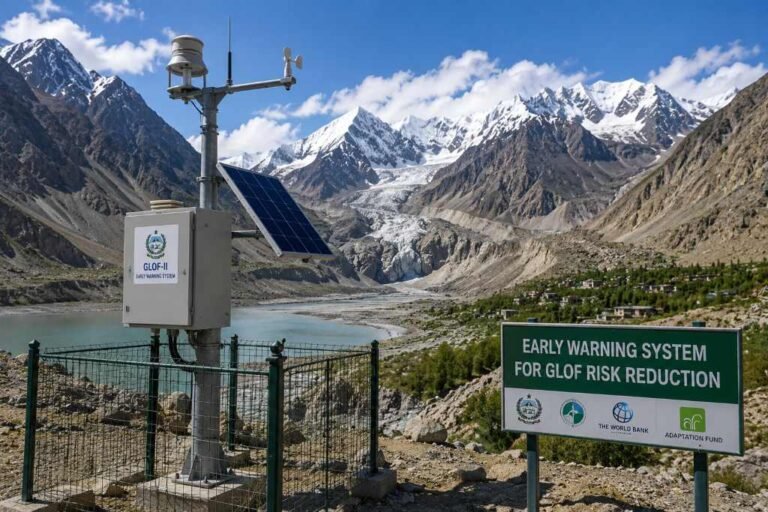
ISLAMABAD, Aug 16 (ABC): Pakistan is installing 286 early warning systems across 24 vulnerable valleys in Gilgit-Baltistan and Khyber Pakhtunkhwa under the $37 million GLOF-II project to strengthen preparedness against glacial lake outburst floods and other climate-related hazards.
According to a document available with Wealth Pakistan, the Ministry of Climate Change and Environmental Coordination (MoCC&EC) is pursuing several initiatives focused on early warning systems, GLOF risk reduction and glacier preservation.
The GLOF-II project covers 24 vulnerable valleys, including 18 in Gilgit-Baltistan and six in Khyber Pakhtunkhwa. The document puts the project’s total cost at $37 million.
The government also plans to operationalise the early warning systems installed under GLOF-II and hand them over to the Pakistan Meteorological Department (PMD).
GLOF risk reduction mechanism strengthened
The government has also taken steps to strengthen the institutional framework for managing risks associated with glacial lake outburst floods.
The ministry established a Technical Committee on GLOF Risk Reduction in May 2026 to strengthen coordination and the institutional response to GLOF risks.
It also submitted a Regional Glaciers Preservation Initiative to the Prime Minister’s Office in August 2025.
According to the document, the initiative proposes scaling up adaptation finance and strengthening regional cooperation and data sharing.
It also calls for greater use of satellite monitoring and advanced sensors. Other proposed measures include expanding multi-hazard early warning systems and promoting nature-based and climate-resilient infrastructure.
More early warning systems planned
Apart from GLOF-II, the Sustainable Action for Ecosystem Restoration in Pakistan (SAFER) project covers five early warning systems.
Four of these systems are in Gilgit-Baltistan and one is in Khyber Pakhtunkhwa. The document puts their cost at $1.86 million out of the SAFER project’s total cost of $10 million.
Another two early warning systems are covered under a project in Buner and Shangla districts of Khyber Pakhtunkhwa.
The project provides one system each for Buner and Shangla. Their combined cost stands at $0.45 million out of the project’s overall cost of $9 million.
Nationwide assessment of systems
The National Adaptation Plan (NAP) project includes an assessment of early warning systems already installed across Pakistan.
According to the document, the assessment component carries a cost of $1.4 million out of the NAP project’s total cost of $2.9 million.
The document also lists the UNDP-Tailored Intelligence for Actionable Early Warning System (TIAEWS) among the initiatives being pursued to strengthen climate-related early warning capacity.
Together, these initiatives cover the installation and assessment of early warning infrastructure, glacier monitoring and institutional coordination.
They also aim to strengthen Pakistan’s preparedness against GLOFs and other climate-related hazards, particularly in vulnerable mountainous areas of Gilgit-Baltistan and Khyber Pakhtunkhwa.