



ISLAMABAD, March 16 (ABC): The government plans to strengthen Pakistan’s agricultural research by building reference genomes of indigenous crops and using artificial intelligence-based models to develop improved crop varieties faster.
The initiative aims to raise agricultural productivity, improve export competitiveness and support better livelihoods for resource-poor farmers. Farmers living in marginal and climate-vulnerable regions are expected to benefit the most.
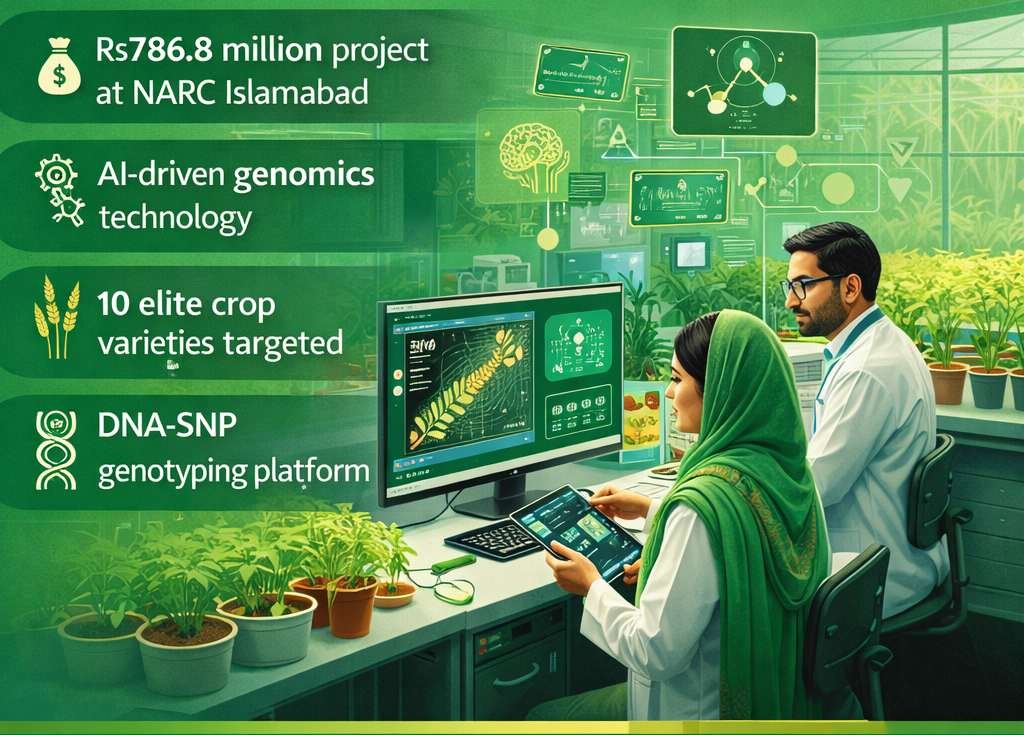
According to official documents available with Wealth Pakistan, authorities have proposed a project titled “Building Reference Genomes and Leveraging AI-driven Models for Improvement of Indigenous Crops.”
Project timeline and cost
The four-year project will run from July 2026 to June 2030. The National Agricultural Research Centre (NARC) in Islamabad will host the project.
The initiative carries an estimated cost of Rs786.816 million. The Pakistan Agricultural Research Council (PARC) will execute the project through the National Institute for Genomics and Advanced Biotechnology (NIGAB).
The document says the initiative will reduce the time required to develop new crop varieties. At the same time, it will strengthen Pakistan’s capacity in modern plant breeding and agricultural biotechnology.
Development of elite crop varieties
Researchers expect the project to produce 10 elite crop varieties.
These include resistant-starch rice and wheat, sugarcane with at least 13.3 percent sugar recovery, and shattering-resistant canola.
To achieve these goals, scientists will use the existing genomics, biotechnology, intelligent glasshouse and speed-breeding facilities at NIGAB.
These facilities will help researchers produce high-quality reference genome sequences for 62 indigenous crop varieties. These varieties belong to 17 major crop species grown in Pakistan.
AI-powered genomic research
The genomic resources will support several advanced agricultural applications.
Researchers will develop 10 cost-effective DNA-SNP (Deoxyribonucleic Acid–Single Nucleotide Polymorphism) genotyping platforms. These platforms will work with AI-enabled genomic selection and speed-breeding systems.
Another component of the project focuses on developing 10 cost-effective 30K SNP genotyping platforms, also known as DNA chips.
Scientists will integrate these platforms into AI-driven genomic selection and speed-breeding pipelines to speed up crop improvement.
National DNA fingerprinting repository
The project will also establish a national DNA fingerprinting repository. Researchers will create DNA fingerprints for 848 crop varieties.
This database will support plant breeders’ rights, varietal certification and crop traceability systems.
In addition, the initiative plans to commercialise next-generation sequencing (NGS), SNP genotyping and bioinformatics services in Pakistan. These services will support breeding programmes in both the public and private sectors.
According to the document, the project aligns with Pakistan Vision 2026 and the Uraan Pakistan Framework under the 13th Five-Year Plan. It also supports national policies on food security, biotechnology and climate resilience, as well as the United Nations Sustainable Development Goals.