


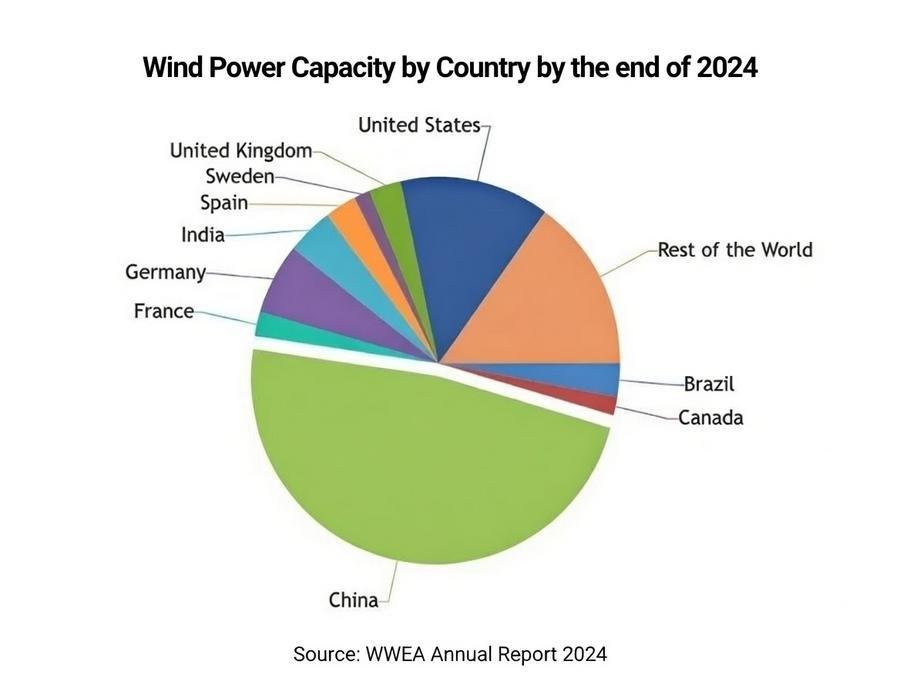

BEIJING, Jan 26 (ABC) : China has firmly established itself as a world leader in wind energy, both in installed capacity and technological innovation, contrary to claims that it manufactures turbines without developing domestic wind farms. Government figures and international reports confirm China’s dominant role in the global renewable energy landscape.
China has maintained the top spot in global installed wind power capacity for 15 consecutive years, reaching 600 million kW by November 2025, according to the National Energy Administration (NEA). In 2024 alone, the country added nearly 80 million kW of new wind capacity, accounting for 72 percent of the global market for new turbines, up from 65 percent in 2023. Wind energy now contributes significantly to China’s electricity supply, with one in every three kilowatt-hours coming from green energy sources.
Over the last decade, China’s wind sector has surged from 130 million kW in 2015 to 600 million kW in 2025, consistently leading the world in annual installations. Since the start of the 14th Five-Year Plan (2021-2025), the combined share of wind and solar power in total electricity consumption rose from 9.7 percent in 2020 to nearly 25 percent by mid-2025. Large-scale onshore wind bases, expanding offshore projects, technological breakthroughs, and government support have transformed wind power from a supplementary source into a central pillar of China’s energy system.
China’s wind energy industry has extended its influence worldwide. In 2024, the country exported 904 wind turbines totaling 5.194 million kW to 23 nations, a 41.7 percent increase over the previous year. By the end of 2024, China had shipped 5,799 turbines with 20.788 million kW capacity to 57 countries across six continents. These exports have helped reduce 4.1 billion tons of carbon emissions globally during 2021-2025. Chinese companies have also pledged approximately $200 billion in overseas clean energy investments since 2022, helping close funding gaps for global climate action.
China’s leadership in wind energy not only strengthens its domestic energy supply but also offers opportunities for Global South nations to achieve low-carbon development, reinforcing its role as a key driver of global sustainable growth.